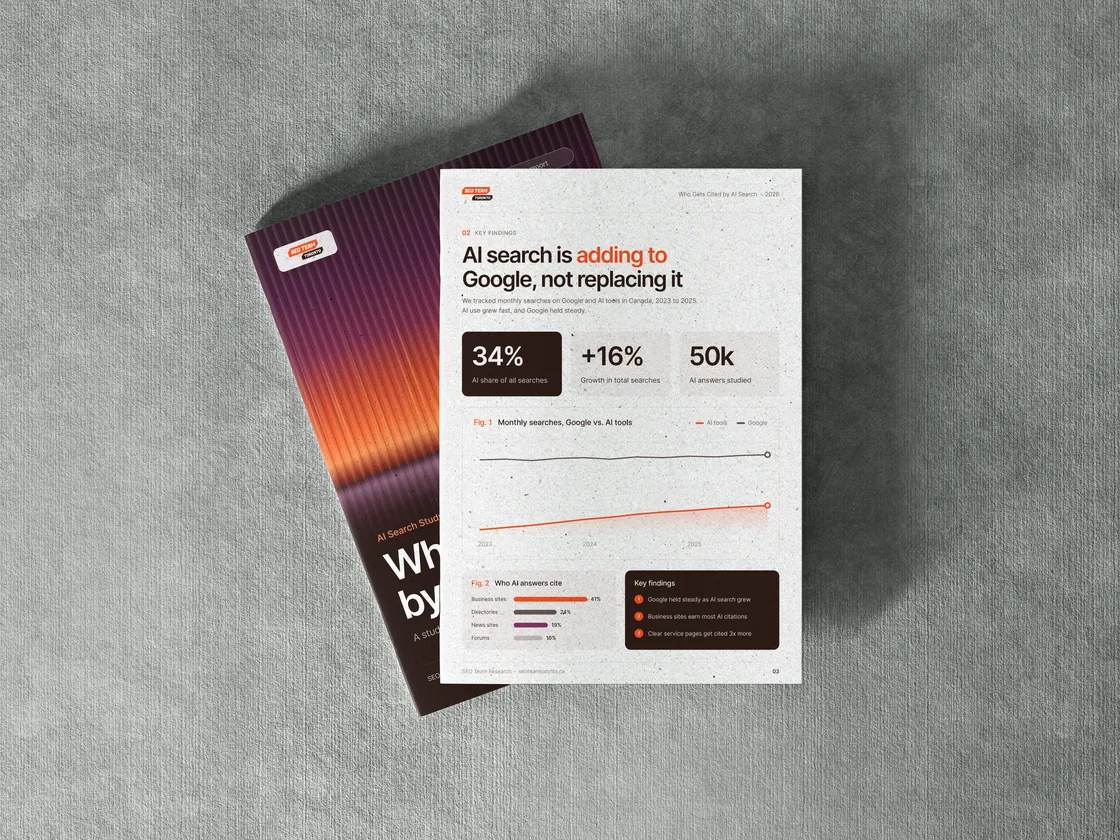





If you are searching for what’s included in SEO packages, you are usually trying to compare two things: what work an agency will actually do, and how you will know it is worth paying for.
That is a reasonable concern. SEO proposals can look similar on paper while the day-to-day deliverables and level of accountability are completely different.
At a glance: a typical SEO agency package includes
- Strategy and prioritization (what to do first and why)
- Technical SEO work (crawl, indexing, speed, architecture)
- On-page improvements (intent match, titles, headings, internal links)
- Content planning and updates (new pages, refreshes, briefs)
- Local SEO (if relevant), especially Google Business Profile work
- Off-page authority building (quality-focused link earning and mentions)
- Tracking, reporting, and a clear monthly plan
At a glance: what is often not included
- Developer hours or website rebuilds
- Design, CRO, and landing page redesigns
- Paid ads management
- Unlimited content production
- One-time projects like migrations, unless scoped separately
The sections below break down what you should expect in an SEO services package, what varies by tier, and the questions that help you compare packages with confidence.
SEO Package vs. SEO Audit vs. Monthly Retainer (Quick Definitions)
Quick Breakdown of the Three Common Models
SEO Audit (one-time)
An audit is a structured assessment of your site’s technical health, content gaps, and opportunities. It is not ongoing execution. A strong audit ends with a prioritized roadmap you can implement internally or with an agency.
Best for: teams that need clarity before committing to a monthly retainer, sites with known technical issues, or businesses switching providers and wanting a clean baseline.
What you should receive:
- A clear findings summary (not just tool screenshots)
- A prioritized action plan (what to fix first, what can wait)
- Page-level recommendations for key templates and priority pages
Monthly SEO Retainer (ongoing)
A retainer is continuous execution: planning, implementing improvements, measuring impact, then iterating month to month. The value comes from consistent prioritization and follow-through, not from a long list of disconnected tasks.
Best for: businesses that want durable growth and ongoing maintenance across technical SEO, on-page, content, and authority building.
What you should receive:
- A monthly plan tied to priorities
- Implemented changes (or dev-ready recommendations, depending on scope)
- Reporting that documents outcomes, completed work, and next steps
Hybrid (audit + retainer)
Hybrid work starts with an audit to establish the baseline and roadmap, then moves into monthly execution. This reduces guesswork and makes reporting more meaningful because you are tracking progress against a defined starting point.
Best for: most businesses investing seriously in SEO, especially when the site has both strategy and technical gaps.
What you should receive:
- Audit artifacts (baseline, roadmap, priority pages)
- Monthly implementation and measurement cadence
- A clear sequence of work over the first 90 days

A Practical Decision Tree
Use this simple decision tree to choose the right starting point:
- Start with an audit if you have not done SEO before, your site has known technical issues, or you are switching agencies and want a clean baseline.
- Start with a retainer if you already have a stable site, clear target services/products, and you need ongoing execution across multiple pages and content.
- Choose a hybrid if you want a structured plan first, then consistent monthly implementation.
If you are in Toronto or the GTA and competing in a crowded local market, the hybrid approach is often the most efficient. It reduces guesswork and makes reporting more meaningful because the baseline is clear.
The Non-Negotiables Every SEO Package Should Include
A good SEO package is not defined by the number of tasks listed. It is defined by whether the work is prioritized, implemented, and measured.
No matter the tier, there are a few inclusions that should be present in every package.
Minimum Viable SEO Package Checklist
If you are comparing SEO agency packages, this checklist is a simple filter. A package does not need to include everything below on day one, but it should include a clear plan for each item.
- Measurement foundation
- Access to Google Search Console and Google Analytics (or an equivalent analytics setup)
- Conversion tracking aligned to your business goals (forms, calls, purchases, bookings)
- Baseline assessment
- A technical and content baseline you can reference later
- A documented list of issues and opportunities, not just “we reviewed your site”
- Keyword and intent mapping
- Clarity on which pages target which searches, and why
- A plan to reduce internal competition between pages (keyword cannibalization)
- Prioritized roadmap
- A 30, 60, 90-day plan that shows sequencing, not a random list of tasks
- Implementation plan
- Who will make changes, how changes are deployed, and how QA will be handled
- Reporting cadence
- A monthly report that includes outcomes, completed work, and the next month’s plan
- Scope boundaries
- Clear notes on what is included, what is optional, and what requires a separate project scope
Google is explicit that helpful, reliable, people-first content and good site quality matter more than shortcuts. Any package that leans on gimmicks should be treated as a risk, not a bargain. (Google for Developers)
What “Proof” Looks Like
To avoid paying for vague activity, ask for tangible artifacts such as:
- A list of pages updated, with notes on what changed and why
- A technical issue log with status (found, in progress, resolved, verified)
- Content briefs or outlines (not just “we wrote content”)
- Reporting that ties work to measurable KPIs, not only keyword rankings
Discovery & Strategy Deliverables (Before Anyone “Does SEO”)
A lot of SEO problems are not technical. They are strategic: the wrong pages target the wrong intent, the site structure does not match how people search, or the business is trying to rank for terms that do not convert.
This is why a strong SEO package starts with discovery and planning.
Common Discovery Inclusions
A typical discovery phase may include:
- Business goals and conversion definitions (what counts as a lead or sale)
- Target regions and service areas (especially for local SEO in Canada)
- Competitor set review (who actually shows up in your searches)
- Site inventory: core pages, templates, duplicates, thin pages
- Current performance baseline: what already drives clicks and leads
- Technical baseline scan: crawlability, indexing, and obvious issues
Strategy Deliverables You Should Expect
A strategy deliverable should be more than a slide deck. It should create a roadmap your team can act on. That usually includes:
- A keyword-to-page map tied to search intent
- A priority list of pages to improve first, and why those pages matter
- A content plan that separates “need-to-have” pages from “nice-to-have” topics
- A 90-day roadmap with a monthly focus and expected leading indicators
If you are working with a team like ours, strategy also includes a practical plan for implementation. In other words, the roadmap includes how changes get shipped and verified, not just what should change.
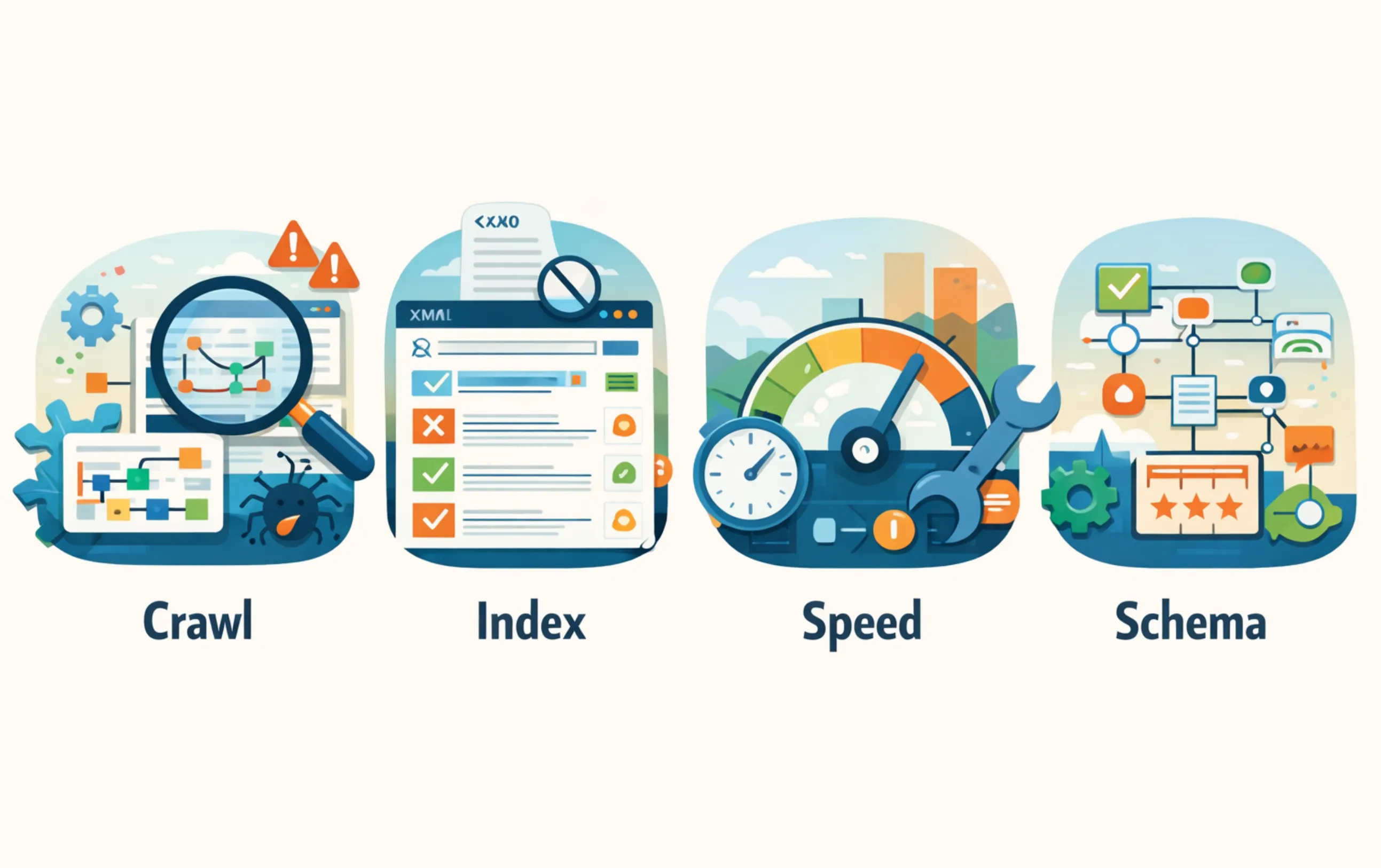
Technical SEO Inclusions (Crawl, Index, Speed, Schema)
Technical SEO is the foundation of most SEO packages, even if the business goal is leads and revenue. If search engines struggle to crawl, index, or understand your pages, content and links become less effective.
This section covers what a technical SEO package typically includes.
For deeper implementation support, this is the type of work covered in our technical SEO services.
Crawl and Index Fundamentals
Common deliverables include:
- Crawl diagnostics to identify blocked or inaccessible pages
- Indexation review to find pages that should not be indexed, or pages missing from the index
- XML sitemap review and improvements
- Canonical and redirect validation (avoid duplicate page signals and redirect chains)
- Basic log review or crawl pattern analysis (site-size dependent)
What to ask for:
- Which templates are creating duplicates
- Which pages are being indexed that should not be
- Which important pages are not being indexed and why
Site Performance and Core Web Vitals
Performance is not only a user experience issue. It can affect how a site is crawled and how users behave after clicking.
A typical package may include:
- Core Web Vitals monitoring (LCP, INP, CLS)
- PageSpeed insights and prioritization of fixes
- Image optimization guidance (compression, next-gen formats, lazy loading)
- Script and third-party tag review (common cause of slowdowns)
Reference the Google for Developers’ Core Web Vitals guidance for definitions and measurement.
Architecture and Internal Linking
This is often overlooked in cheaper packages because it is not a single “task.” It is ongoing site hygiene.
Typical deliverables:
- Navigation and hierarchy improvements so key pages are not buried
- Internal linking recommendations tied to priority pages
- Fixing orphaned pages and weak clusters
- Pagination and faceted navigation handling for large sites
What to ask for:
- How the agency decides which internal links to add and where
- Whether they map topic clusters to service/product pages
Structured Data and SERP Enhancements
Structured data (schema) is not a ranking shortcut, but it can improve clarity and eligibility for certain rich results.
Typical deliverables:
- Organization or LocalBusiness schema setup (if applicable)
- Service, Product, Article schema where relevant
- Validation and monitoring for schema errors
What to ask for:
- Which schema types they recommend and why
- How they validate implementation (testing tools, Search Console enhancements)
Technical QA and Release Validation
One of the biggest gaps in SEO packages is the “after” step. Many issues come back because changes were not validated.
A stronger package includes:
- Post-release QA checks (crawl, indexing signals, template integrity)
- Monitoring for regressions after site updates
- Change logs so you know what was shipped and when
On-Page SEO Inclusions (Intent Alignment + Page Upgrades)
On-page SEO is where most SEO packages turn into real business outcomes. It is the layer that connects search intent to the page a human sees.
If you want to see how we structure this work, it aligns with our on-page SEO services.
What On-Page Work Usually Includes
For priority service or product pages, typical deliverables include:
- Search intent analysis (what the query actually needs)
- Title tags and meta descriptions written for clarity and clicks, not stuffing
- H1 and heading hierarchy cleanup so the page reads cleanly
- Content restructuring to answer key questions faster
- Internal linking improvements to strengthen priority pages
- FAQ additions when they help users and match real questions
What “Good” Looks Like in Practice
A strong on-page package does not just change headings. It also:
- Removes sections that do not support the intent
- Adds proof elements that help users decide (examples, process, FAQs, service area details)
- Improves scannability so the page is usable on mobile
- Clarifies the conversion path so users can take the next step without searching again
If an agency promises “on-page optimization” without explaining which pages, which intent, and what changes, it is usually a sign the work will be light.
Content Strategy + Production Inclusions (What’s Actually “Included”)
Many SEO packages say “content included.” That phrase can mean anything from a full content strategy to a generic blog post each month.
The better question is: what kind of content work is included, and how is it tied to the pages that drive revenue.
This is the work we typically cover under content marketing when content is part of the SEO plan.
Content Strategy Deliverables
A content strategy inside an SEO package may include:
- Topic research based on how your audience searches
- A content calendar tied to business priorities
- A content gap analysis (what competitors cover that you do not)
- A plan for new pages vs refreshes (often the fastest wins are refreshes)
- Internal linking plan that supports service or product pages
Content Production Deliverables
Production varies by package tier. It may include:
- Content briefs for internal teams to execute
- Drafting and editing by the agency
- Content uploads and on-page formatting in your CMS (if in scope)
- Image or asset recommendations (not always creation)
What a Good Content Brief Includes
If content is included in your monthly SEO package, ask for briefs that include:
- The target query and 3 to 5 supporting questions
- Search intent summary (what the page must help the reader do)
- Required sections and headings
- Sources to cite when making claims
- Internal links to include, and why
- A checklist for quality and accuracy
This approach aligns with Google’s emphasis on helpful, people-first content that satisfies the reader, not content made to fill a publishing quota. (Google for Developers)
Local SEO Inclusions (Google Business Profile + Citations + Location Pages + Reviews)
If you are a service business, a multi-location brand, or a business with a defined service area, local SEO deliverables can be a major part of SEO packages.
In Toronto and the GTA, local rankings can shift quickly because competition is dense in many categories. That makes consistent local work important.
This is the type of work we cover through local SEO services.
Google Business Profile Work
Typical package inclusions:
- Category review and optimization
- Services, products, and attributes setup where relevant
- Business description updates aligned to the real offering
- Photo and post recommendations (or posting, depending on scope)
- Q&A monitoring and basic spam reporting when issues arise
Citations and NAP Consistency
Citations are not glamorous, but inconsistent business information can create trust issues across the local ecosystem.
Typical deliverables:
- Audit of existing citations and duplicates
- NAP consistency cleanup (Name, Address, Phone)
- Listing suppression or consolidation when duplicates exist
- Expansion to relevant directories (quality over quantity)
Location Pages and Service Area Pages
A local SEO package often includes:
- Location page creation or upgrades
- Service area coverage where appropriate
- Clear differentiation between locations to avoid duplicate content signals
- Internal linking between locations, services, and supporting content
Review Strategy and Local Tracking
Reviews are not only social proof. They also help conversion.
Common deliverables:
- A review request process that fits your operations
- Guidance on responses and category patterns
- Local rank tracking for priority terms and locations
Google frames local visibility around relevance, distance, and prominence. It is a useful lens for evaluating whether a local SEO package is complete. (Google Business Profile Help)
Off-Page SEO Inclusions (Authority Building Without Risk)
Off-page SEO is often shortened to “link building,” but that is not the full picture. Authority comes from quality signals: relevant mentions, trusted links, and strong brand presence across the web.
This is the work covered in our off-page SEO services.
What Off-Page Work Typically Includes
Depending on your industry and competition, a package may include:
- Link profile review and risk assessment
- Prospecting for relevant link opportunities (industry associations, partners, PR angles)
- Digital PR or content-led outreach to earn coverage
- Unlinked mention reclamation (turning mentions into links where appropriate)
- Ongoing monitoring for suspicious link spikes or low-quality patterns
What to Watch For
Off-page work is where SEO packages can quietly become risky.
Red flags include:
- Guaranteed link quantities
- Links from unrelated sites with thin content
- Private blog networks or “guest post farms”
- No explanation of relevance and quality standards
Google’s spam policies are clear that manipulative link practices can create long-term problems. If a package is vague about link sources and quality, that is a decision point. (Google for Developers)
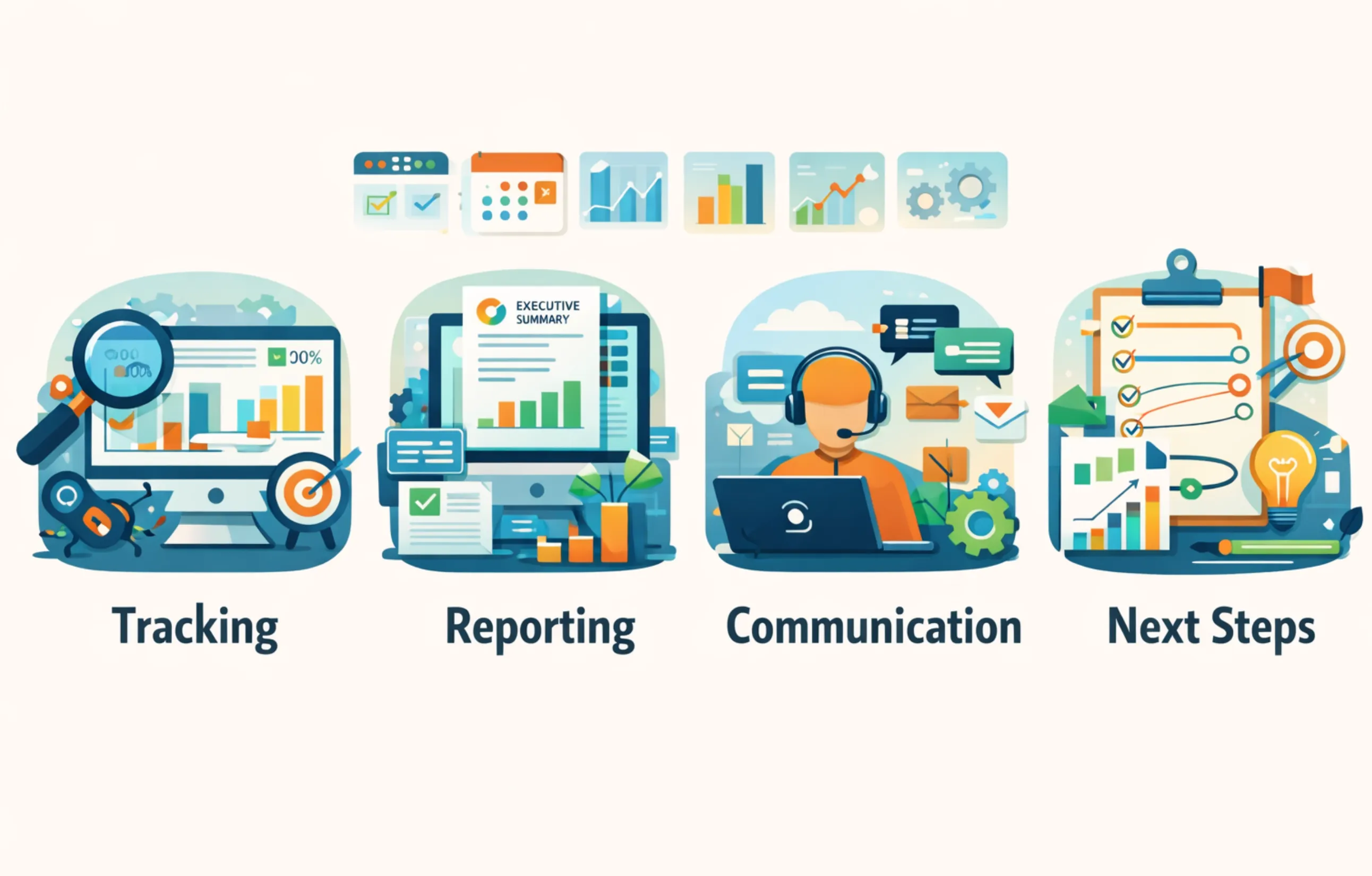
Tracking + Reporting + Communication (What You Should Receive Monthly)
SEO packages often include reporting, but reporting quality varies more than most buyers expect. A good monthly report does three jobs:
- It shows performance trends that matter to the business.
- It documents work completed in plain language.
- It sets the next month’s plan, tied to priorities.
What Should Be Set Up (Or Confirmed) Early
A solid measurement baseline usually includes:
- Google Search Console access and verification
- Analytics setup (GA4 or equivalent)
- Conversion tracking that reflects your funnel
- Call tracking or booking tracking if calls or appointments are your primary conversion
- A dashboard or monthly summary format that stays consistent
If you cannot measure outcomes, you are paying for activity, not performance.
What a Monthly SEO Report Should Include
A good monthly report is usually short and direct, with links to detail where needed.
Look for these sections:
- Executive summary: what changed, what mattered, and why
- KPI snapshot: organic clicks, impressions, conversion actions, and qualified leads where available
- Work completed: specific pages, fixes, content shipped, and links earned
- Issues discovered: what surfaced this month and what it means
- Next month plan: priorities, expected leading indicators, and dependencies (dev, approvals, content)
Mini Example: What “Measured Execution” Looks Like
A Toronto-area service business came to us with steady impressions but inconsistent leads from organic search. Their existing SEO retainer focused heavily on “blog content” without improving the service pages that actually convert.
In the first phase, we cleaned up indexing issues, clarified internal linking so key services were easier to discover, and rebuilt several service pages around the questions people ask before they call. We also tightened Google Business Profile categories and service descriptions.
The measurable shift was not a single keyword “jump.” It was a steadier increase in qualified form submissions and calls tied to the service pages, alongside clearer Search Console trends that supported the story of what was improving and why.
Results vary by market and site condition, but this is the baseline standard: strategy, implementation, and measurement should connect.
What’s Often Not Included (And What Becomes an Add-On)
One of the fastest ways SEO retainers go off-track is scope confusion. Many SEO packages assume a certain level of cooperation and access that is not written clearly.
Here is what is commonly excluded or scoped separately.
Common Exclusions in SEO Packages
- Developer work: implementing complex technical fixes, template changes, or server-side updates
- Design and CRO: landing page redesigns, A/B testing, UX improvements
- Major content volumes: unlimited blogs, product copy rewrites across hundreds of pages
- Website migrations and rebuilds: platform changes, domain moves, re-platforming
- Paid media: Google Ads, Meta Ads, landing page funnels
- Creative production: photography, video, custom graphics (often optional)
A Simple Responsibility Matrix to Clarify
Before you sign, clarify who owns each area:
- Agency-owned: research, roadmap, technical recommendations, content briefs, on-page updates (when CMS access is provided), reporting
- Shared: approvals, subject matter expertise, brand positioning, review responses
- Client or dev-owned (unless scoped): code changes, design changes, platform work, deployments
This is not about pushing work back to you. It is about avoiding unrealistic expectations and missed timelines.
A good SEO agency package will define these boundaries in writing.
AI Search Reality: What SEO Packages Should Include in 2025+
Search results are not only “10 blue links” anymore. AI summaries, featured snippets, People Also Ask, and zero-click experiences shape what users see first.
That does not make SEO less important. It changes what “good SEO” needs to include.
Google has published guidance on how AI features use content from the search index and the same foundational SEO principles apply. (Google for Developers)
Why This Changes SEO Package Deliverables
In practical terms, many businesses will see:
- More impressions without the same click growth
- More visibility for “answer-style” queries
- More competition for attention above the fold
Independent research has also highlighted how many searches do not end in an open-web click, which reinforces the need to earn trust quickly when you do get the visit. (SparkToro)
AI Readiness Checklist for SEO Packages
A modern SEO package should include work that makes your pages clearer to both humans and machines. Here is a practical checklist:
- Snippet-ready structure
- Direct answers near the top of key sections
- Clean headings that match real questions
- Short blocks of text that stand on their own
- Evidence and clarity
- Claims supported with credible sources when appropriate
- Clear definitions for industry terms
- Entity consistency
- Consistent naming for services, locations, and offerings across the site
- Strong “About” and trust elements where users can validate who you are
- Technical eligibility
- Pages are indexable, fast enough, and not blocked by technical errors
- Structured data is implemented and validated where it helps
- Monitoring
- Tracking changes in impressions, clicks, and query patterns as the SERP evolves
- Regular content refresh work, not only new content
This is not about trying to “trick” AI systems. It is about making your site easier to understand and easier to trust.
If you are evaluating packages, ask directly whether the agency has a plan for AI-driven SERP realities, and what work will change because of it.
How to Compare SEO Packages (Scorecard + Red Flags + Questions)
This is the section most buyers wish they had before signing a retainer.
A good SEO package is rarely the cheapest. It is the one with the clearest plan, the strongest execution, and the most transparent measurement.
A Simple Package Scorecard (Use This on Proposals)
Score each area from 1 to 5. A strong package will score well across the board, not only in “number of deliverables.”
- Strategy quality
- Is there a clear priority order?
- Do they explain how pages are mapped to intent?
- Implementation clarity
- Who ships changes?
- Do they describe QA and verification?
- Technical depth
- Do they go beyond surface scans?
- Is there a system for tracking technical issues through resolution?
- On-page and content quality
- Are pages improved for real intent, not only keywords?
- Are content briefs and refresh plans included?
- Local SEO coverage (if relevant)
- Is GBP work included?
- Are citations and location pages addressed?
- Off-page risk management
- Do they explain quality standards for links and mentions?
- Do they avoid volume-based promises?
- Reporting and accountability
- Do you get a monthly plan and documented work completed?
- Are KPIs tied to conversions, not only rankings?
Red Flags That Should Slow You Down
- Guarantees about rankings, traffic, or results
- Vague language like “we will optimize your website” with no page list or plan
- “Secret methods” or refusal to explain what will be done
- Link guarantees that do not explain relevance, quality, or sources
- Reporting that focuses on vanity metrics without business outcomes
- No discussion of who implements changes and how they are validated
Questions Worth Asking Before You Sign
- Which pages will you prioritize in the first 30 days, and why those pages?
- What is included each month as a minimum, regardless of priorities?
- What access do you need, and what changes will you make directly vs recommend?
- How do you handle technical fixes that require development work?
- What does your monthly report look like, and what KPIs do you track?
- What is not included, and what typically becomes an add-on?
- How do you approach authority building without creating risk?
- How will you adapt the plan as search results and AI features change?
Key Takeaways
- A good SEO services package is a system: strategy, implementation, and measurement.
- The best packages produce tangible artifacts you can review, not vague activity.
- Scope clarity matters as much as deliverables, especially around development and design.
- Modern packages should account for AI summaries and zero-click behaviours through clearer structure, stronger trust signals, and consistent monitoring.
If you want a package built for today’s search environment, including AI-driven SERP realities, we can help you plan and implement a structured approach through our AI readiness service.