







The Problem
Search is shifting to AI Overviews and assistants, but most sites are not machine clear to be cited. Facts sit in long paragraphs, entities are vague, and off-site data conflicts with what the site says. The schema is inconsistent, headings and FAQs are weak. Google Business Profile and directories disagree.
The Impact
Strong answers get skipped or credited elsewhere. Traffic plateaus, assistants surface stale details, and local visibility slips. Fewer citations, slower discovery of updates, and weaker trust when facts mismatch.
The Solutions
Make answers easy to extract and verify, then align off-page signals. We structure content, complete schema, reconcile entities, and keep a simple facts base. On-page: precise headings and FAQs, JSON-LD (Organization/LocalBusiness, Service/Product, Article/FAQ, Author), canonicals and last updated. Off-page: consistent NAP, aligned author profiles, monitoring of AI Overviews.

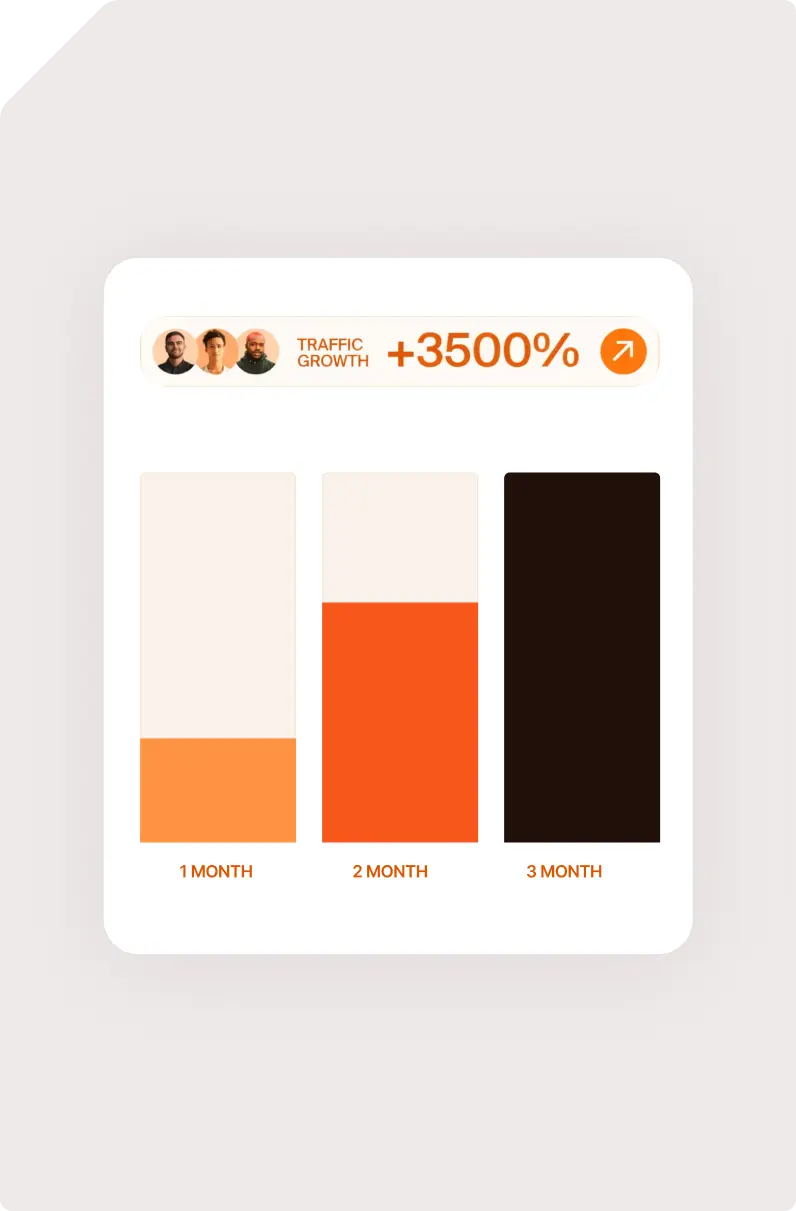
Clients have experienced these results after 6 months
On-Page Structure for AI Retrieval
We make answers easy for models to extract without losing classic SEO strength.
Schema and JSON-LD Coverage
We clarify the meaning for machines across your key page types.
Entity Consensus and Knowledge Graph
We align the people, places, and things your brand represents.
Off-Page Alignment and Listings
We make off-site data match what you claim on-site.
Author, Publisher, and Credibility Signals
We strengthen the signals models look for when choosing sources.
AI Overview Monitoring and Evaluation
We track inclusion and iterate so your best answers get cited.
Our Methodology
Discovery
We learn your goals, market, and current site, then audit and set baselines.
Strategy & Roadmap
We turn findings into a 90-day plan with clear priorities, owners, and timelines.
Implementation & Execution
We ship fixes and improvements on a steady cadence with QA on each release.
Reporting & Iteration
We review results monthly, adjust the plan, and stack gains that compound.
AI Readiness is the work that improves the odds of your pages being cited in AI Overviews, AI Mode and assistant answers, without weakening classic rankings.
Precision matters here, because the category is full of vendors selling tactics that do nothing. Google's May 2026 guidance confirms its AI features run on the same core ranking and quality systems as organic Search. So the foundation is conventional SEO done properly, with an additional layer on top.
That layer is content structured so a specific question gets a specific answer near the top, first-hand expertise and data a model can attribute, visible authorship, and entity information that stays consistent between your website, your Google Business Profile and third-party profiles.
What it is not is a separate discipline with its own file formats. Google has confirmed that Search ignores llms.txt, that content chunking is unnecessary, and that no AI-specific schema exists. Those files are fine to maintain for other systems that read them. Nobody should be selling them to you as a Google ranking tactic.
We can make pages eligible and improve the odds. Nobody can guarantee inclusion, because Google selects sources automatically and that selection shifts query by query.
Eligibility starts with the basics. A page has to be indexable, renderable without JavaScript blocking the content, and technically sound enough to be crawled reliably. If technical SEO is broken, no amount of AI-specific work matters.
Beyond that, the factors that appear to move citation odds are a direct answer positioned near the top of the relevant section, specific and sourced claims rather than general explanation, visible authorship and expertise, and consistent entity data that feeds the knowledge graph a model draws on.
One detail worth knowing. A majority of AI Overview citations come from pages that are not in the top ten organic results for the query being answered, because AI Mode generates sub-queries, the query fan-out, and pulls sources for those. A page can therefore earn citations by answering a narrow sub-question well, even without a strong headline ranking. That changes which pages are worth prioritizing.
Start where question-shaped queries already exist. Pricing pages, comparison pages, FAQs and your strongest explainer content, then high-intent service and location pages.
The logic is that AI answers are generated in response to questions, so pages already structured around a question have the shortest path to citation. A page titled "how much does X cost in Toronto" that opens with an actual figure is far easier to cite than a service page that opens with positioning.
After that, prioritize by commercial value rather than volume. Ten citations on queries your buyers genuinely ask is worth more than a hundred on general-interest topics that never convert.
Case studies and cornerstone guides come next, because they carry the first-hand evidence models weight when choosing between similar sources. In practice most of this overlaps with good on-page work, which is why we do not run the two as separate projects.
Citation share against named competitors, tracked over time across AI Overviews and the major assistants, then tied back to traffic and leads from the pages being cited.
Search Console now includes a generative AI performance report, which gives first-party data on how content performs in Google's AI features rather than relying entirely on third-party estimates. That is the most reliable source available and we report from it directly.
Alongside it we monitor a defined prompt set for your category across Google's AI features, ChatGPT and Perplexity, checking which sources get named and whether your AI search visibility improves against it. Tracking a fixed set of prompts month over month is far more meaningful than a single snapshot, because outputs vary between runs.
The honest limitation is that no external tool has access to how these systems select sources. Anyone presenting an "AI ranking score" as though it were measured is presenting a model of their own making. We report what is observable, mark what is inferred, and connect both back to the analytics that show whether any of it produced revenue.
No. Most of the work is structural rather than editorial, and your voice stays as it is.
The typical changes to an existing page are moving the direct answer higher, tightening headings so each section addresses one question, adding a source or a figure where a claim is currently general, and making author bios and credentials visible. None of that requires rewriting the page.
Where a rewrite does make sense is on pages that are thin, or that were written for a keyword rather than a reader. Those need work regardless of AI, and we would flag them as on-page or content priorities rather than AI Readiness ones.
One thing we push back on. There is a style of writing produced specifically to be machine-readable, stripped of personality and reduced to clipped declarative statements. It reads badly to humans, and Google has stated directly that AI-specific rewriting is unnecessary. Content that works for readers is what gets cited.
It runs inside the program rather than beside it, because the same work drives both outcomes. Google's own position is that optimizing for its generative features is still SEO.
In practice, technical SEO determines whether pages can be crawled and rendered at all. On-page structure determines how cleanly an answer can be extracted. Content supplies the expertise and data worth citing. And off-page work builds the reputation and consistent entity signals that make a source look trustworthy in the first place.
AI Readiness is the layer that makes sure those pieces are aligned for extraction as well as for ranking.
Treating it as a separate line item is where budgets get wasted. We have reviewed generative engine optimization (GEO) and answer engine optimization (AEO) proposals charging separately for services that amounted to adding FAQ sections and schema, both of which belong in standard on-page work. If a vendor cannot explain how their AI service differs from good SEO, that is usually because it does not.