SEO for AI Overviews is less about new tactics and more about making your best answers easy to find, easy to extract, and easy to trust. In 2025, many search journeys begin with an AI summary, and the sources that get cited tend to be clear, specific, and verifiable.
For Toronto and GTA businesses, this shift has a practical implication: content still needs to rank, but it also needs to read well as a “supporting source” inside an answer engine. That means tighter structure, better proof, and fewer weak sections that create ambiguity.
Below is the structure we use when we want content to perform across classic organic results, People Also Ask, featured snippets, and AI Overviews.
Quick Answer: The 7 Elements Answer Engines Extract (And How to Implement Them)
If you want a single checklist to start with, use this. These are the page elements that answer engines can reliably extract and cite.
- Eligibility (Indexed + Snippet-Ready)
- Confirm the page is indexable, crawlable, and renders the main content for Google.
- Avoid thin pages or pages where the primary answer is hidden behind tabs, logins, or heavy scripts.
- A Direct Answer Block Near the Top
- Include a 1–2 sentence answer that can stand alone.
- Follow with 3–6 bullets that clarify scope, steps, or decision criteria.
- Question-Led Headings That Match How People Search
- Use H2s that mirror real queries (what, how, when, cost, timeline, best option).
- Start each section with the answer, then expand.
- Scannable Formatting (Lists and Tables Where They Fit)
- Steps: numbered lists.
- Comparisons: short tables (or “Option / Best For / Tradeoff” bullets).
- Definitions: single-paragraph blocks with clear terms.
- Evidence and Verifiability
- Add sources for important definitions, rules, and stats.
- Include dates and region context for numbers (example: “U.S., March 2025”).
- Entity Clarity
- Make it obvious who the page is about, who it is for, and what it applies to.
- For local brands, reinforce service area and location signals in a natural way.
- A Clean Next Step
- Each page should guide a reader to the next logical action: a related guide, a service page, or a contact path.
- Internal links should feel like navigation, not a sales pitch.
What’s Actually Changing in Search (AI Overviews, AI Mode, and ‘Answer Engines’)
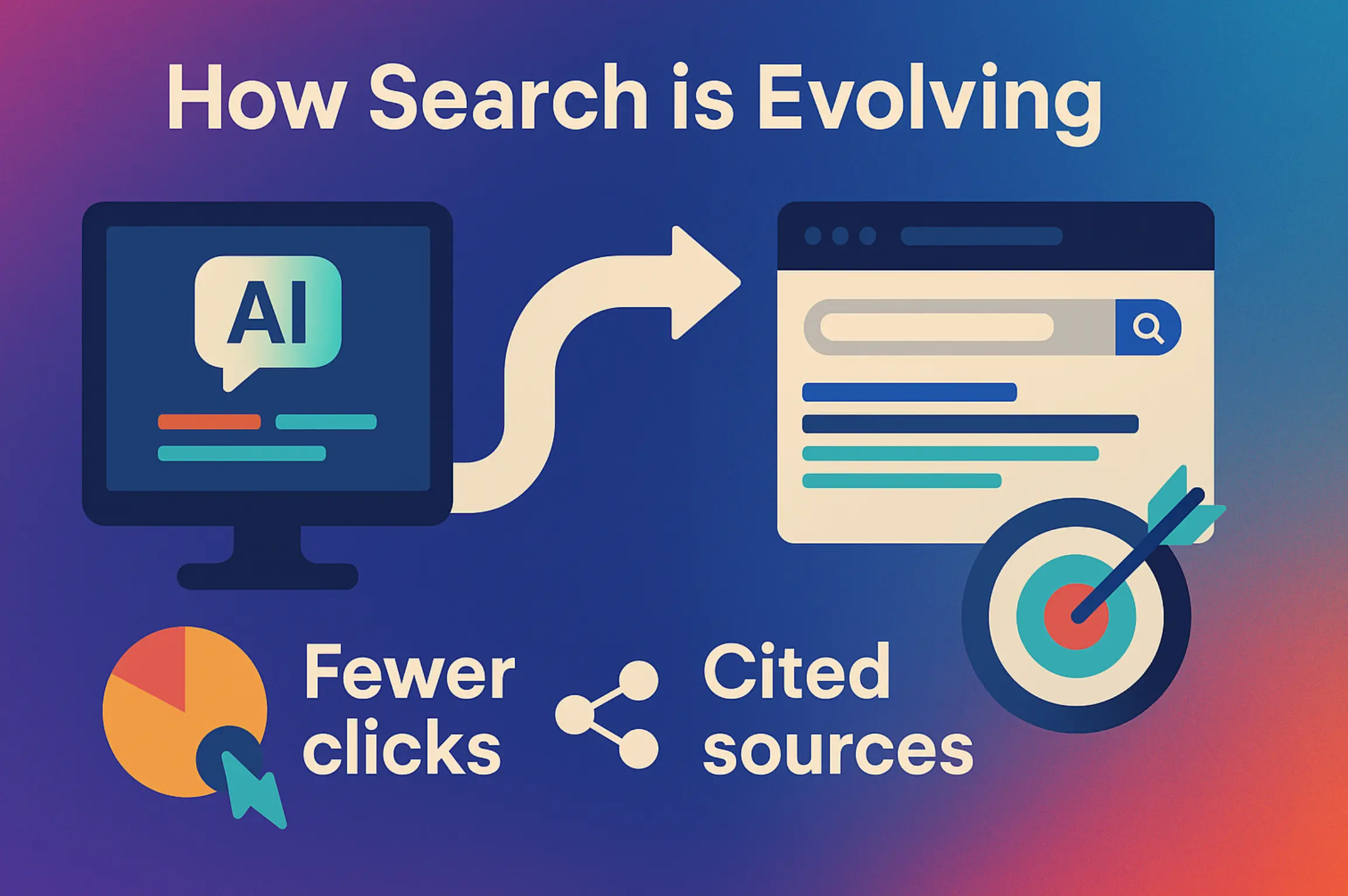
AI Overviews and AI Mode change how information is assembled and displayed on the results page. Google describes these features as experiences where an AI response is generated and supporting links are surfaced, often using a “query fan-out” approach to gather information across related subtopics (AI features and your website).
Two shifts matter most for content teams:
- More searches end without a traditional click. In a Pew Research Center analysis of Google searches from March 2025, pages with an AI summary led to fewer clicks on traditional results, and clicks on cited sources inside the summary were rare (Pew Research Center).
- Answers are assembled from multiple sources. Your goal is not only to “rank” but to be a clean, citable source for a specific sub-question.
You will see new terms around this shift:
- Answer Engine Optimization (AEO): structuring content so it answers questions in a way that can be extracted and cited.
- Generative Engine Optimization (GEO): optimizing for generative responses that blend multiple sources into one answer.
Google’s guidance is clear on one point: there are no special requirements to appear in AI Overviews or AI Mode beyond strong foundational SEO and eligibility (AI features and your website). The work is still “classic” SEO, applied with more discipline around structure, clarity, and proof.
A data point worth planning around: SEOClarity reports AI Overviews appeared for 30% of U.S. desktop keywords as of September 2025, and more than 99% of AI Overview sources in their study came from the top 10 results (SEOClarity study). Ranking still matters, and structure influences who gets cited.
How AI Overviews Choose Sources (Eligibility + Retrieval Basics)
From a site owner perspective, the first question is not “How do I optimize for AI Overviews?” The first question is “Can Google reliably access, understand, and quote this page?”
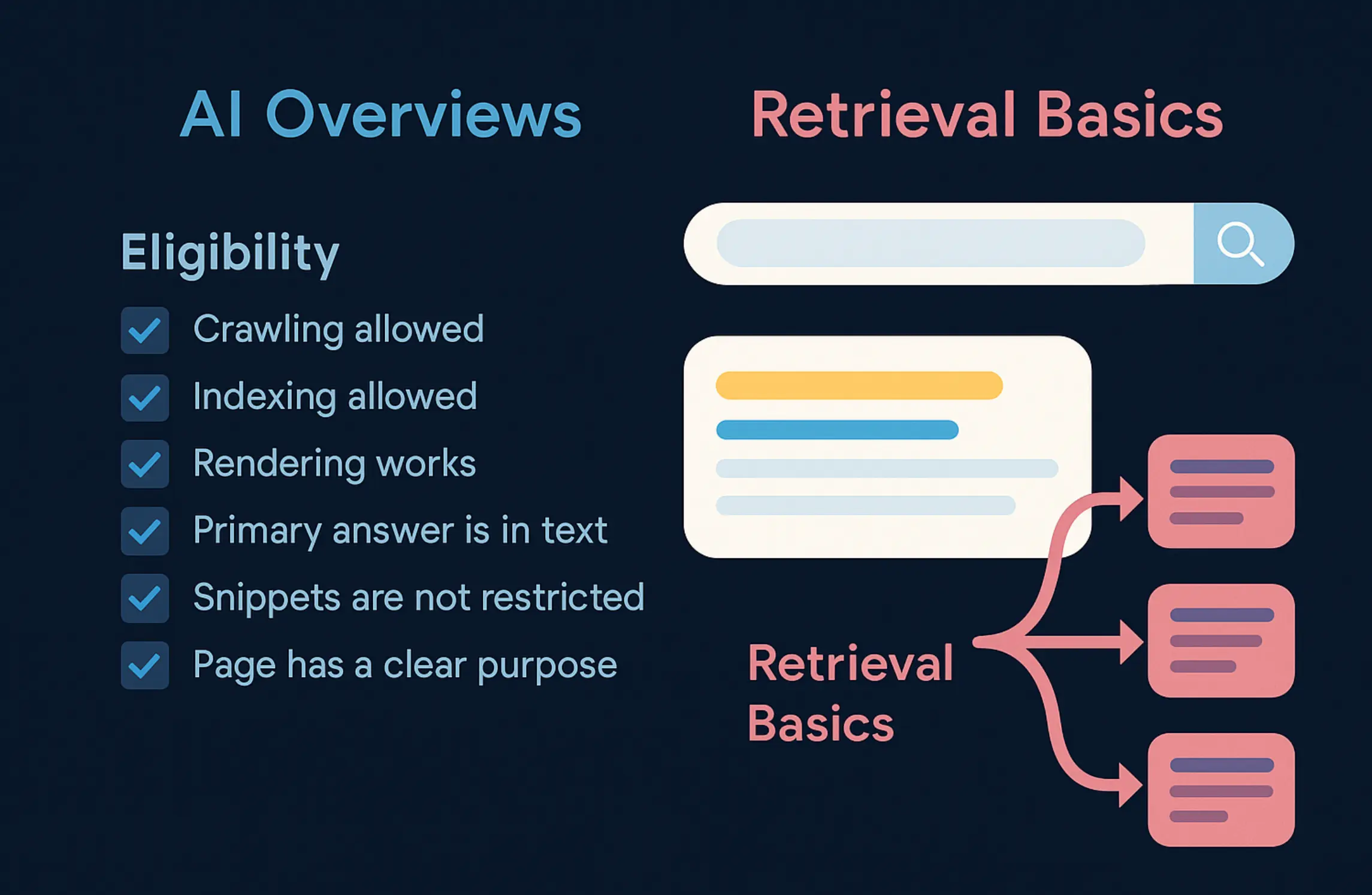
Google’s documentation notes that to be eligible to show as a supporting link in AI features, a page needs to be indexed and eligible to appear with a snippet in Search (AI features and your website).
Eligibility Checklist (Start Here)
Use this list before you rewrite a single paragraph:
- Crawling allowed: robots.txt and server/CDN rules are not blocking Googlebot.
- Indexing allowed: no accidental noindex, incorrect canonicals, or soft-404 behavior.
- Rendering works: the primary content loads and is visible in the rendered HTML.
- Primary answer is in text: the key information is not trapped in images, embedded tools, or blocked scripts.
- Snippets are not restricted: preview controls do not unintentionally prevent snippets.
- Page has a clear purpose: the title, H1, and first screen align to one intent.
Retrieval Basics (Why Structure Matters)
Google explains that AI features may use “query fan-out,” which means the system explores related subtopics and supporting questions (AI features and your website). In practice, that rewards pages that:
- Answer the main question quickly.
- Also address the natural follow-ups inside clear, self-contained sections.
- Use headings that look like real queries.
This is why “SEO for AI Overviews” is often won by improving the best pages you already have, not by publishing new pages for every minor variation. The goal is coverage and clarity without bloat.
The Answer-Engine Content Blueprint (A Repeatable Page Model)
When we structure content for answer engines, we use a simple model that works for AI Overviews, People Also Ask, and featured snippets.
The I-A-C-E-N Framework
Intent → Answer → Context → Evidence → Next Step
- Intent: Define one job for the page (inform, compare, decide, or act).
- Answer: Provide a short, direct response early. Treat it like it could be quoted.
- Context: Add the “how” and “why” with steps, definitions, and boundaries.
- Evidence: Back key claims with sources, dates, and clear attribution.
- Next Step: Guide the reader to a logical follow-on action or related page.
What This Looks Like on a Page
- Top of page: 1–2 sentence answer + bullet summary
- Middle: H2 sections framed as questions, each with a direct first-paragraph answer
- Support: examples, checklists, comparisons, and references
- Bottom: key takeaways + next-step CTA
This model matters because it creates “clean blocks” that can stand alone. It also keeps content useful to humans even if a reader never scrolls past the first screen.
Structure for Extractability (Headings, Answer Blocks, Lists, Tables)
Answer engines do not reward mystery. They reward clarity.
Heading Rules That Work
- Use specific H2s. “How AI Overviews Choose Sources” is stronger than “How It Works.”
- Prefer question-led headings when a section is answering a search query.
- Keep H2s and first sentences tightly aligned. If the first sentence does not answer the H2, revise.
The Answer Block Template
Use this at the start of important sections:
- Direct answer (1–2 sentences)
- Scope bullets (3–6 bullets)
- Details (2–4 short paragraphs)
- Proof (source link, definition link, or data point)
When to Use Lists and Tables
- Lists are best for steps, requirements, and “do this first” guidance.
- Tables are best for comparisons. If your CMS makes tables awkward, use a consistent bullet format:
- Option
- Best for
- Tradeoff
- What to look for
Mini Example: Before vs. After (Anonymized)
A Toronto-based service business had a “Process” section that looked like this:
Before (hard to extract):
“Our team starts by reviewing your site, then we plan improvements across technical and content areas, and we implement changes over time based on priorities and results.”
After (quotable + specific):
What Is the SEO Implementation Process?
SEO implementation is the structured work of auditing, prioritizing fixes, applying changes, and validating outcomes in Search Console.
- Step 1: Technical audit and indexing checks
- Step 2: On-page restructuring for top-intent pages
- Step 3: Content updates with citations and clear FAQs
- Step 4: Validation (crawl, index, performance, tracking)
- Step 5: Iteration based on query patterns and conversions
The “after” version does two things: it answers the heading immediately, and it creates a set of extractable steps without adding extra words.
Make Answers Verifiable (Citations, Dates, Authors, and a Simple Facts Base)
If AI Overviews are assembling answers from multiple sources, “being correct” is not enough. You also need to be verifiable.
Google’s own guidance for AI search experiences emphasizes useful, satisfying content that is genuinely valuable and reliable (Succeeding in AI search experiences). The same principle sits underneath Google’s people-first guidance (Creating helpful, reliable, people-first content).
The “Facts Base” for Service and Strategy Pages
Build a simple facts base that stays consistent across your site:
- What the service is, and what it is not
- Who it is for (industry, company size, use case)
- Service area details (for Toronto/GTA local intent)
- Process, timelines, and deliverables
- Pricing approach (even if you avoid exact pricing, clarify ranges and variables)
- Proof points (case summaries, benchmarks, methodology notes)
- Definitions for key terms you use (avoid hand-wavy language)
Verifiability Checklist
- Every meaningful statistic includes a source, date, and region.
- Claims that sound absolute are softened unless you can prove them.
- Pages that can go stale include a “last updated” note in the CMS.
- Citations point to primary sources when possible (official documentation, research orgs).
- The page reads clearly, even if a single paragraph is extracted and shown alone.
This is how you avoid content that feels like a rewrite of competitors. It also makes your pages safer to quote.

Structured Data That Still Matters (And What Not to Over-index On)
Structured data does not replace content. It helps search engines understand what your content is about and can support rich results when you follow quality guidelines (Google structured data overview).
What Still Matters for Most Businesses
For service businesses and B2B brands, structured data should be accurate and boring:
- Organization or LocalBusiness (depending on business model)
- Service where it reflects visible service information
- BreadcrumbList for clean hierarchy
- Article markup for blog posts (with author/date fields in the CMS)
The rule is simple: do not mark up what is not visible. Keep it aligned to the page the user is reading.
What Not to Over-Index On
Two structured data patterns are commonly overused:
- FAQ rich results: Google announced that FAQ rich results are largely limited to well-known, authoritative government and health sites, and are not shown regularly for most other sites (Google Search Central blog update).
- HowTo rich results: HowTo visibility has been reduced and changed over time. In 2025, “HowTo markup” should not be your strategy. A well-structured how-to section is still valuable for users and for extractability.
You can still publish FAQ sections because they help users. Treat FAQ markup as a secondary technical decision, not a growth plan.
On-Page SEO for AI + Classic Rankings (Intent Mapping, Internal Linking, CTR)
Answer engines do not remove the need for on-page SEO. They increase the need for it.
Start With Intent Mapping
- Map your primary queries to one page per intent.
- Decide what the page is supposed to achieve: inform, compare, qualify a lead, or convert.
- Consolidate or differentiate pages that compete for the same intent.
If you need a structured rebuild of page intent and on-page hierarchy, our on-page SEO work is designed around this type of mapping and rewrite plan.
Internal Linking That Supports Answers
Internal linking is not only for crawl flow. It also gives retrieval systems a cleaner view of site structure.
- Link from broader guides to specific service pages.
- Link laterally between related guides so follow-up questions are one click away.
- Use anchors that reflect the user’s next question, not a generic keyword.
CTR Still Matters
AI summaries can compress the top of the SERP, so titles and snippets need to earn the click that remains.
- Write titles that match the query language and clarify scope.
- Use meta descriptions that promise a specific outcome (template, checklist, example), without clickbait.
- Align the first paragraph to the promise in the title. A mismatch creates quick bounces.
Technical SEO Prereqs for Answer Engines (Indexability, Rendering, Performance)
If your page is hard to crawl, hard to render, or inconsistent across templates, it becomes harder to cite. This is also where many AI visibility efforts fail quietly.
A technical baseline for answer-engine eligibility includes:
- Clean crawl and index signals (robots, sitemaps, canonicals, status codes)
- Stable template rendering (especially for JavaScript-heavy builds)
- Fast, usable pages that do not bury the main content
- Structured data that validates and matches visible content
If you suspect technical issues are limiting indexability or snippet eligibility, start with a technical SEO audit and implementation plan. For many sites, this is the highest-leverage first step because content structure cannot help pages that are not reliably accessible.
Practical Technical Checklist
- Run URL-level checks in Search Console (indexing, canonical, rendering).
- Validate structured data for key templates.
- Check for duplicate and near-duplicate pages that split relevance.
- Confirm the primary content loads without requiring user interaction.
- Fix internal link gaps so important pages are reachable within a few clicks.
Authority + Entity Alignment (Off-Page, Local, and Brand Consistency)
Answer engines are conservative about sources. They tend to cite brands and pages that appear stable, consistent, and trustworthy.
Entity Consistency Is a Quiet Advantage
Make sure the same facts appear consistently across:
- Your website (about page, service pages, contact details)
- Your Google Business Profile and citations
- Your directory listings and brand profiles
For local businesses, strong local SEO for Toronto and the GTA still matters because many local-intent queries are served by map results and local packs.
A useful nuance from seoClarity’s dataset: AI Overviews rarely appeared for local keywords in their tracking, which suggests classic local SEO remains a primary channel for “near me” and service-area discovery (seoClarity study).
Authority Still Comes From the Web
If you want more consistent citation potential, you still need earned authority.
- Build links and mentions that reflect real relevance, not volume.
- Prioritize editorial coverage and industry citations over low-quality directories.
- Strengthen the brand footprint that answer engines can cross-check.
This is the focus of our off-page SEO and digital PR approach: durable authority that supports both rankings and citation likelihood.
Measurement: How to Track AI Overview Citations and What to Do With the Data
If you do not measure AI visibility, you will guess. In 2025, guessing is expensive.
Two measurement realities to keep in mind:
- AI summaries and cited sources can change over time. Pew’s methodology notes that results reflect the time the search results were collected, and summaries may vary (Pew Research Center).
- AI Overviews are not universal across queries, and coverage varies by intent and context.
A Practical Tracking Workflow
- Build a priority query set (20 to 50 queries).
Include your highest-intent informational questions, comparison terms, and pre-purchase qualifiers. - Record the SERP pattern weekly.
For each query, note:- AI Overview present or not
- Which sources are cited
- Your organic rank range
- The page being cited (if it is yours)
- Tag each query by intent.
Informational, commercial investigation, transactional, local. - Treat changes as prompts for iteration.
Update the specific section that should win the citation. Do not rewrite the whole page unless you need to.
Decision Rules (What to Do With What You See)
- You rank well but are not cited: tighten the answer block, add proof, and make the section more extractable.
- You are cited but traffic quality is poor: adjust the page’s next step, clarify scope, and align the snippet with the real offer.
- You are not ranking and not cited: fix fundamentals first, then restructure.
This is also where an editorial system helps. If your team needs a repeatable content production and refresh program, our content marketing services are built around governance, briefs, and update cycles that reduce drift.

Key Takeaways and Next Steps (What to Do in the Next 30 Days)
Key Takeaways
- AI Overviews do not require special “AI SEO,” but they reward clean eligibility, clarity, and proof.
- Structure is now a ranking and citation advantage: question-led headings, direct answers, and scannable blocks.
- Verifiability matters more than ever. Citations, dates, and consistent facts reduce ambiguity.
- Structured data helps when it reflects visible content, but it is not a shortcut.
- Measurement needs to include citation presence and query patterns, not only rankings.
A Calm 30-Day Plan
Week 1: Eligibility and Technical Baseline
- Validate indexing, rendering, canonicals, and snippet eligibility for top pages.
- Fix obvious blockers and template issues.
Week 2: Apply the I-A-C-E-N Blueprint to 3 to 5 Priority Pages
- Add direct answer blocks near the top.
- Rewrite headings into question-led, extractable sections.
- Add citations and scope boundaries.
Week 3: Build Supporting Sections for Query Fan-Out
- Add follow-up sections that match real People Also Ask style questions.
- Add internal links that reflect next-step intent.
Week 4: Track, Compare, and Iterate
- Monitor 20 to 50 queries weekly.
- Update the specific section that should win the citation, not the entire page.
If you want a structured plan that covers eligibility, content structure, entity consistency, and measurement, explore our AI readiness services.