Healthcare is one of the most demanding environments in search. SEO for doctors operates inside what Google calls Your Money or Your Life (YMYL) territory, where the stakes of bad information are high enough that Google applies its most rigorous quality standards. As Google's helpful content guidance explains, content affecting health, finances, or safety receives elevated scrutiny through the E-E-A-T framework: Experience, Expertise, Authoritativeness, and Trustworthiness.
This is not a space where a few keyword tweaks move the needle. Ranking here requires a disciplined strategy, a credible content foundation, and consistent local SEO execution. We covered healthcare in our roundup of the hardest industries for SEO in 2026. This guide goes deeper on exactly what doctors and practice managers need to do to build sustainable visibility.
Why SEO for Doctors Requires a Different Playbook
Most businesses can publish helpful content, earn links, and grow organic traffic through a standard SEO process. For medical practices, that process is necessary but not sufficient. SEO for doctors also demands a visible trust architecture: named physicians on content, verifiable credentials, transparent privacy policies, and HTTPS security at minimum.
Google's search quality raters are trained to flag YMYL pages where medical authority is unclear or content lacks cited support. When those ratings signal low quality, algorithm updates follow. This is why healthcare sites are consistently the most affected by Google's core updates, and why practices that invest early in E-E-A-T rarely experience the same volatility.
Working with an SEO agency that understands YMYL compliance means the foundation gets built right from the start. At SEO Team Toronto, we treat E-E-A-T architecture as a prerequisite, not an afterthought, before any content or link work begins.

E-E-A-T: The Foundation Every Medical Practice Needs
Author Credentials and Content Review
Every educational or clinical page on a practice website should carry a named physician author or reviewer with visible credentials. Google's quality raters look specifically for this on health content. A licensed professional's name, specialty, and institution should appear on the page, not buried in a footer or omitted entirely.
The on-page SEO work that supports E-E-A-T includes structured schema markup using the Physician or MedicalOrganization schema types, clear heading hierarchies that signal content intent, and FAQ sections that answer specific patient questions. These elements reinforce credibility signals at the page level, not just the domain level.
Trust Signals Across the Site
A complete About Us page with team profiles, a transparent contact page, board certifications, hospital affiliations, and patient privacy policies all contribute to domain-level trust. These are not decorative pages. They are part of how Google evaluates whether a practice website is a legitimate, authoritative healthcare source.
SEO Team Toronto audits all of these signals as part of our intake process for healthcare clients. If the trust foundation is weak, ranking improvements are short-lived. If it is solid, the content and local SEO work we layer on top compounds effectively. Speak with an SEO specialist to understand where your practice currently stands.
Local SEO for Doctors: Winning the Map Pack
For most independent practices, the Google Map Pack is the highest-value organic traffic source available. BrightLocal's Local Consumer Review Survey consistently shows that the majority of consumers research local businesses online before visiting, and healthcare is no exception. Patients searching for a physician, specialist, or clinic near them are high-intent and ready to book.
Google Business Profile Optimization
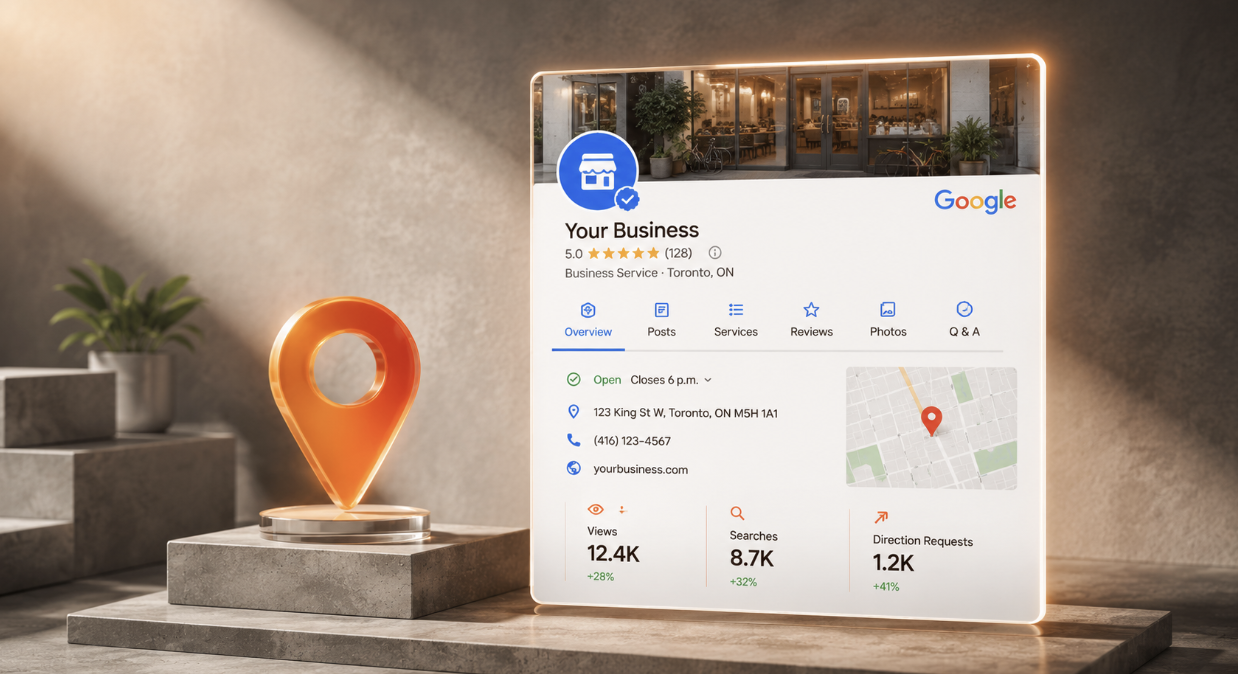
A fully optimized Google Business Profile (GBP) is the single most important factor for Map Pack rankings. Moz's Local Search Ranking Factors research consistently identifies GBP signals as the top driver of local pack visibility. For medical practices, category selection is critical: a specific category like Orthopedic Surgeon or Family Medicine Physician will always outperform a generic Medical Office category because it matches actual patient search queries.
Beyond category, the profile needs accurate and current hours, appointment booking links, services listed with keyword-relevant descriptions, and a steady cadence of updated photos. Google treats an active, maintained profile as a legitimacy signal.
Our local SEO services include a full GBP audit and optimization as part of every healthcare engagement. We configure the profile to reflect how patients actually search, not how a clinic describes itself internally.
Patient Reviews and NAP Consistency
Reviews are the second most important ranking factor for the local pack, according to BrightLocal's 2026 Local Search Ranking Factors survey. For medical practices, review velocity (the steady rate of new reviews) matters as much as total volume. Practices that earn consistent genuine reviews outrank competitors who have more total reviews but stopped collecting them months ago.
NAP consistency (Name, Address, Phone Number) across every directory listing is equally important. Discrepancies between your practice website, GBP, Healthgrades, and insurance network directories suppress local pack visibility by creating conflicting signals. Our team audits and corrects these as a standard step in onboarding.
For a complete checklist of local signals to audit, see our local SEO checklist for Canadian businesses.
Content Strategy: Publishing YMYL-Safe Health Content
Content is where medical practices either build lasting authority or create compliance risk. Effective SEO for doctors requires a publishing model where every piece of content has a named clinical expert, a clear factual basis, and citations patients and search engines can verify.
Keyword Strategy for Medical Practices
Patient-language queries drive more traffic than clinical terminology. Patients search for "pain in lower right abdomen" rather than "right iliac fossa discomfort." Effective keyword mapping for medical practices means building content around how patients actually describe symptoms and needs, not how physicians document them.
Condition pages and procedure explainers are often the highest-converting organic pages a practice can publish. A well-structured page targeting a specific condition treats both informational and navigational intent simultaneously, attracting patients at the research stage and converting them when they are ready to book.
Content Format and AI Visibility
Health content now triggers AI Overviews in a significant portion of searches. According to Search Engine Land's analysis of YMYL content, health queries are among the most frequent AI Overview triggers. Practices that structure content with clear question-and-answer formats, concise FAQ sections, and properly implemented schema are positioning themselves to be cited in AI-generated answers, not just traditional blue links.
Our guide on SEO for AI Overviews and generative search covers the structural principles that apply directly to healthcare content. At SEO Team Toronto, we build these formats into every content brief we produce for medical clients.
What to Avoid
Publishing health content without named medical authorship, making outcome claims without citations, copying condition descriptions from other websites, and bulk-publishing thin service pages are all patterns Google's quality systems actively flag. These issues compound quickly on practice websites that have many service pages with templated copy.
Our technical SEO process identifies duplicate content, thin pages, and conflicting schema before they become ranking liabilities.
Link Building for Medical Practices
Off-page authority in healthcare builds through editorial credibility, not volume. The most valuable links for SEO for doctors come from health journalism, local news coverage, hospital affiliation pages, medical association directories, and patient advocacy organizations. Generic link volume does not move the needle here the way targeted editorial links do.
Healthcare journalists and editors are actively seeking physician commentary on health trends and local practice stories. A physician who contributes an expert perspective to a regional health publication earns a credible editorial link that strengthens both domain authority and brand trust. Our off-page SEO team handles this outreach process, identifying relevant publications and positioning your practitioners as expert sources.
Healthgrades, RateMDs, and provincial medical association directories also provide foundational citation signals that reinforce NAP consistency and support local pack rankings. These are baseline, not optional.

Technical SEO for Healthcare Websites
Technical SEO for doctors involves risks unique to the healthcare environment. Patient portals, appointment booking systems, and multi-location structures all create crawl and indexation challenges if not properly configured. Getting this layer right is what allows every other part of the SEO for doctors strategy to function.
Appointment booking pages should be canonicalized or noindexed unless they contain rankable content. Multi-location practices need unique, locally optimized pages for each clinic, not templated pages with swapped addresses. Practices that have undergone website migrations or rebrands often carry redirect chains and orphaned pages that quietly suppress authority. This is one of the most common issues we uncover in new healthcare client audits at SEO Team Toronto.
Core Web Vitals performance matters here as much as any other vertical. Slow pages create patient experience problems that become SEO problems. Our technical SEO services address crawl budget, indexation control, page speed, and schema implementation, building the stable infrastructure that content and link strategies need to work.
Why Medical Practices Partner With SEO Team Toronto
The combination of YMYL standards, local search competition, and technical complexity means SEO for doctors is not a DIY project or a general marketing retainer. It requires a team that understands Google's quality guidelines, knows how to build E-E-A-T signals correctly, and can execute across technical, content, and local channels simultaneously.
SEO Team Toronto works with medical practices and healthcare providers to build organic visibility that holds up through algorithm updates. We handle the full strategy: E-E-A-T architecture, GBP optimization, content production with clinical review, technical audits, and link outreach to healthcare publications. You focus on patient care. We build the search presence that brings them to you.
If you want to understand what results look like in the first few months of an engagement, our guide on what to expect in your first 90 days with an SEO agency walks through the full timeline.
SEO Team Toronto builds YMYL-compliant SEO strategies for healthcare providers.
Ready to grow your practice through search? Get a free SEO proposal from SEO Team Toronto.
Frequently Asked Questions
What makes SEO for doctors different from standard SEO?
Medical content falls inside Google's YMYL category. Google's own documentation states that health content receives greater weight for E-E-A-T signals than general content. Author credentials, cited sources, and domain trust matter far more here than in most other industries.
How long does SEO for doctors take to show results?
Most practices see measurable local search movement within three to six months. YMYL sites can take longer because trust signals build incrementally through reviews, backlinks, and content depth. Practices that start with a strong E-E-A-T foundation consistently reach results faster.
Do patient reviews affect SEO for doctors?
Yes, significantly. Reviews are among the top local pack ranking factors, per BrightLocal's Local Search Ranking Factors research. Consistent, recent reviews from genuine patients signal credibility to both Google and prospective patients. A structured review generation process is part of every local SEO strategy we build.
What content performs best for SEO for doctors?
Condition-specific pages, procedure explainers, and FAQ-format content targeting patient-language queries consistently perform well. All content should be written or reviewed by a licensed practitioner and cite reputable medical sources. Thin, templated service pages with no clinical depth are the most common content liability we see on practice websites.
Is SEO worth the investment for independent practices?
For independent practices competing against hospital systems and corporate clinic networks, SEO for doctors is one of the highest-ROI patient acquisition channels available. Our breakdown of the real ROI of organic search provides a framework for calculating return before committing to a budget.
Want a customized SEO plan built around your practice and patient market? Speak with an SEO specialist at SEO Team Toronto today.