








The Problem
Most e-commerce sites have the same pain points that reflect in their performance: product pages that look good but do not match search intent, collections that compete with each other, low-value URLs and weak internal linking that leaves best sellers buried. When problems pile on, search engines stop trusting what to rank.
The Impact
When e-commerce SEO is not built as a system, rankings fluctuate, products fail to index, and the store relies too heavily on paid traffic to hit targets. You lose visibility for category terms, miss out on non brand demand, and watch competitors win the first click even when your products are stronger.
The Solutions
We run e-commerce SEO like a performance program. We fix technical issues that block crawling and indexing, build collection and product page structures that match real buyer searches, and strengthen internal linking so your top categories and best sellers earn authority. The result is more qualified traffic, better category rankings, and stronger conversion from organic sessions.

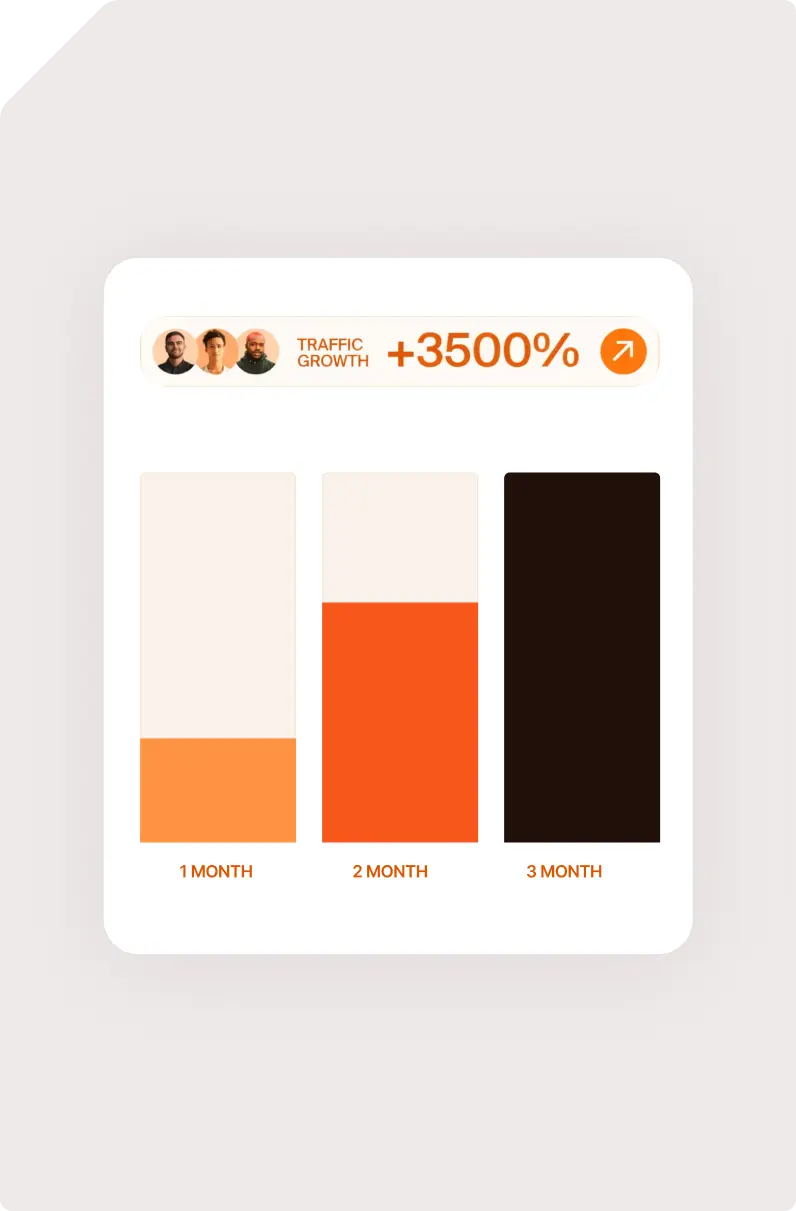
Clients have experienced these results after 6 months
Product Page SEO
We optimize product pages so shoppers and search engines understand value fast.
Collection and Category SEO
We build category pages that rank for competitive commercial searches consistently.
Technical SEO for E-Commerce
We remove crawl waste and indexing friction that holds large catalogs back.
Site Architecture and Internal Linking
We strengthen authority flow so important pages are never buried.
Content Strategy for E-Commerce Growth
We build demand beyond product pages with content that supports purchase decisions.
SEO Reporting and Conversion Tracking
We connect rankings and traffic to revenue outcomes and profitable growth.
Our Methodology
Discovery
We learn your goals, market, and current site, then audit and set baselines.
Strategy & Roadmap
We turn findings into a 90-day plan with clear priorities, owners, and timelines.
Implementation & Execution
We ship fixes and improvements on a steady cadence with QA on each release.
Reporting & Iteration
We review results monthly, adjust the plan, and stack gains that compound.
E-commerce SEO is the work that gets your category and product pages ranking for the searches shoppers use when they are ready to buy.
It differs from standard SEO mainly in scale and in what ranks. Category and collection pages usually drive far more organic revenue than individual product pages, because they capture higher-volume non-branded terms earlier in the decision. Most stores over-invest in product pages and under-invest in categories.
The work splits three ways. Technical control over what gets crawled and indexed, which matters enormously once filters and variants start multiplying URLs. Page-level optimization of categories and products with unique content and product schema. And supporting content such as buying guides and comparisons that captures demand before a shopper has settled on a product.
Organic search drives roughly a third of e-commerce traffic across the market, more than paid, email or social individually. For most Toronto stores it is the largest channel nobody is actively managing. It works best when it sits inside a full SEO program rather than as a one-off catalogue cleanup.
Technical and indexing fixes often move things within weeks. Category-level ranking gains build over three to six months, and compounding growth comes after that.
The early wins usually come from products that were never being crawled properly to begin with. On large catalogues, faceted navigation can absorb a substantial share of crawl budget, which means Googlebot spends its time on filter combinations nobody searches while genuine product pages go undiscovered. Fixing that produces fast, visible movement precisely because the pages already existed.
Category pages take longer, because they compete for higher-volume commercial terms where established retailers already hold position. That is a relevance and authority problem rather than a technical one, and it does not resolve in a month.
Seasonality complicates the reading. A store selling seasonal goods will see organic swing with demand regardless of SEO, so we baseline year over year rather than month over month. Platform matters too, since some fixes need theme or template work before they can ship at all.
Index bloat from faceted navigation, duplicate product content, thin category pages, slow performance, and internal linking that leaves best sellers buried five clicks deep.
Faceted navigation is the biggest by some distance. Filter combinations across size, colour, price and brand can generate millions of near-identical URLs, and on badly configured stores that consumes a large share of crawl budget. The fix is a set of deliberate rules about which filter combinations are indexable, which get canonicalized, and which get blocked outright. It has to be a decision, not a default.
Duplicate product content is second. Manufacturer descriptions used verbatim across dozens of retailers give Google no reason to prefer your version over anyone else's.
Thin category pages are third and the most commonly overlooked. A grid of products with no supporting copy gives a search engine almost nothing to assess, which is why category pages so often underperform relative to the revenue they could carry. Most of this is technical SEO applied at catalogue scale.
Yes. Shopify, WooCommerce, Magento and custom builds. The fundamentals stay the same, but each platform imposes different constraints and each has its own recurring problems.
On Shopify the usual issues are duplicate product paths through collections, limited control over robots and canonical behaviour, app bloat slowing the theme, and collection architecture set up for merchandising rather than search. Most fixes land in the theme.
On WooCommerce it tends to be plugin load, database performance under a large catalogue, and product attributes quietly generating archive pages nobody intended to publish.
On Magento and Adobe Commerce it is layered navigation, indexation rules and URL rewrites, and almost all of it needs developer time rather than admin settings. We work within what the platform allows rather than treating a replatform as the answer to everything. If a move really is the right call, it becomes a migration project with its own plan, not something bolted onto a monthly retainer.
By organic revenue and the metrics that lead to it, not by traffic volume.
The reporting set is organic revenue and its share of total, category-level rankings on commercial terms, product visibility for high-intent queries, organic conversion rate, average order value from organic, and index coverage health across the catalogue, with Merchant Center feed health added where Shopping and free listings matter.
Index coverage deserves attention even though it sounds purely technical. On a large store, the ratio of indexed pages to pages actually worth indexing is one of the clearest early indicators of whether a program is working. Bloat falling while product coverage rises usually precedes revenue movement by a month or two.
We separate branded from non-branded as well. Branded organic revenue often looks healthy while non-branded stays flat, which means the store is harvesting demand it already had rather than generating new demand. Only one of those is SEO doing its job. Where paid search runs alongside, we report both together so budget can shift as organic takes over commercial terms.