




How long does SEO take? For many established websites, meaningful search visibility starts to improve within roughly 3–6 months, while stronger traffic, lead, and revenue impact often takes 6–12 months or longer. A new domain, highly competitive market, large ecommerce site, or enterprise program may require a longer runway.
That range is more useful than promising a fixed date, but it is still incomplete. The real SEO results timeline depends on the site you start with, the competition around your priority searches, how quickly recommendations are implemented, and what you consider a “result.”
A site can start gaining impressions before traffic increases. Rankings can rise before qualified leads follow. A technical fix can show an effect faster than building authority for a competitive commercial query.
The right question is not simply, “When will SEO start working?” It is: Which signals should improve first for this type of website, and when should slow progress become a concern?
How Long Does SEO Take? The Short Answer
SEO commonly takes 3–6 months to produce measurable movement and 6–12 months or more to produce stronger, sustained business impact. Those are planning ranges, not guarantees.
Google itself does not provide a universal ranking timetable. Its SEO Starter Guide explains that some changes may be reflected relatively quickly, while others can take several months for Google to process and reassess.
Define “SEO Results” Before You Set a Timeline
One reason SEO timelines cause frustration is that different people use the word “results” to mean different things.
An SEO specialist might see progress because relevant impressions have doubled. A marketing director may be watching organic opportunities in the CRM. A business owner may only count completed calls or sales.
All three views matter, but they sit at different points in the process.
A practical way to measure SEO is through three stages:
Visibility
Search engines first need to discover, crawl, understand, index, and reassess the relevant pages.
Early signs include:
- priority URLs being indexed correctly
- more impressions for relevant searches
- additional queries appearing in Search Console
- pages moving from outside the top 50 into competitive range
- improved local visibility for relevant searches
Traffic
Visibility needs to turn into clicks from searches that matter.
At this stage, look for:
- growth in non-branded organic clicks
- higher rankings for commercially relevant queries
- more traffic reaching priority service or category pages
- improved click-through rates where rankings and search presentation support it
Business Impact
The final stage is whether organic traffic contributes to commercial outcomes.
Depending on the business, that may mean:
- qualified leads
- phone calls
- bookings
- ecommerce transactions
- demo requests
- revenue
- assisted conversions or pipeline
This creates a simple framework:
Visibility → Traffic → Business Impact
The stages overlap, but they should not be expected to mature at exactly the same time.
A site can therefore be “working” from an SEO perspective before revenue has fully caught up. At the same time, rising impressions alone should not be treated as proof that the strategy has succeeded.
What Changes Between Month 3 and Month 18?
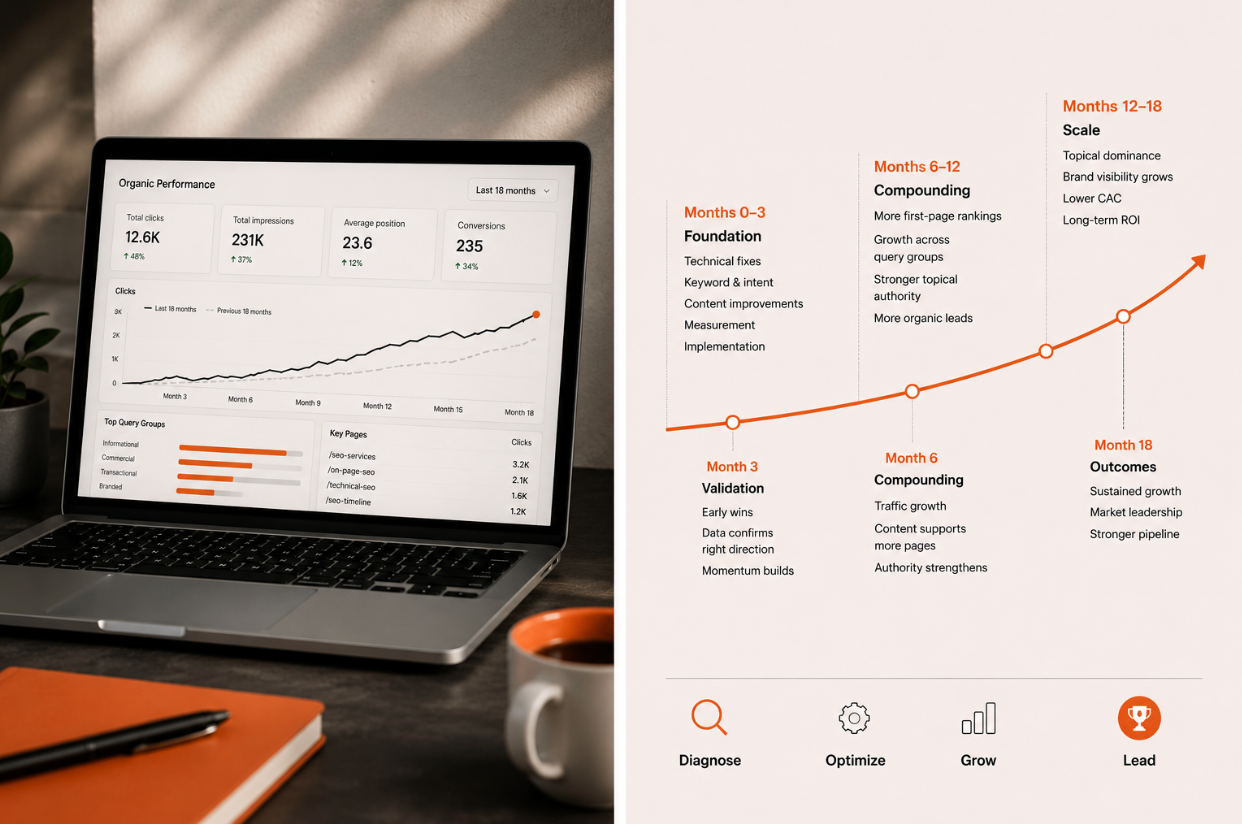
The opening months of an SEO engagement usually focus heavily on diagnosis, prioritization, technical issues, search intent, page improvements, measurement, and implementation.
The more important question for a long-term SEO timeline is what happens after that initial foundation is in place.
Months 3–6: Validation
Months three through six are often where an SEO strategy begins producing enough data to judge whether the direction is sound.
You may see:
- more relevant non-branded impressions
- priority pages entering stronger ranking positions
- long-tail queries improving before highly competitive head terms
- refreshed pages gaining a wider set of queries
- new content beginning to receive consistent impressions
- early qualified leads from organic search
The goal at this stage is not necessarily to have reached the final target. It is to validate that the site is moving toward it.
For an established site, this is also where well-chosen on-page SEO improvements can start separating high-potential pages from pages that need a different approach.
Months 6–12: Compounding
When technical health, content quality, internal linking, and authority work together, SEO becomes more cumulative.
A useful page does not only generate its own traffic. It can support related pages through internal links, expand topical coverage, earn external references, and give search engines more evidence about what the site should be visible for.
By months six through twelve, a healthy program may show:
- more stable first-page rankings
- growth across groups of related queries
- stronger performance from commercial pages
- more pages contributing organic traffic
- increased qualified organic conversions
- clearer separation between effective and ineffective content
This is also the point when reporting should move beyond isolated keyword wins. The larger question is whether organic search is becoming a more meaningful acquisition channel.
Months 12–18: Scale or Diagnose the Plateau
A mature SEO program should not simply repeat the same activities indefinitely.
Between months twelve and eighteen, successful programs often expand into more difficult search topics, additional product or service categories, new geographic opportunities, or stronger authority-building initiatives.
If progress has stalled, this is also the point to diagnose why.
Questions should include:
- Have the highest-impact recommendations actually been implemented?
- Are we targeting searches the site can realistically compete for?
- Does the content offer anything better or more useful than the current results?
- Are important pages receiving sufficient internal and external authority?
- Are rankings improving without producing qualified traffic?
- Has the competitive landscape changed?
- Is technical debt continuing to limit crawling, indexing, or rendering?
At this stage, “SEO takes time” is no longer a sufficient explanation for persistent flat performance.
How Long SEO Takes by Site Type
A useful SEO forecast starts with the website itself.
Two companies can invest the same amount in SEO for six months and experience very different curves because they started from different positions.
Brand-New Website
A brand-new site usually requires the longest runway.
It begins without the search history, existing ranking footprint, content library, links, brand demand, and accumulated authority that an established competitor may already have.
Early impressions can still appear within weeks or months, particularly for specific long-tail queries. Competing consistently for valuable commercial searches usually takes longer.
As a planning range, a new site may require:
- 2–4 months to establish early search visibility
- 6–12+ months for meaningful traffic across a useful set of searches
- 9–18+ months for stronger performance in competitive commercial categories
These are not waiting periods imposed by Google. They reflect the amount of work required to build a competitive search presence from a limited starting point.
A 2025 Ahrefs study on ranking-page age illustrates the challenge. In one random sample, only 1.74% of newly published pages reached Google's top 10 within a year, while 72.9% of pages already ranking in the top 10 were more than three years old.
That does not prove that Google applies a fixed “sandbox” to new websites. It does show that new pages often compete against mature assets with years of accumulated signals.
Established Small or Mid-Sized Business Site
Established websites can move faster when useful assets already exist.
A service page sitting in positions 12–20 is a different starting point from a page that has never been indexed. Improving search intent alignment, content depth, internal links, page structure, and authority may push an existing asset forward without starting from zero.
A reasonable planning range is:
- 1–3 months for early movement in existing pages
- 3–6 months for clearer gains across priority queries
- 6–12 months for broader commercial impact
The biggest advantage is optionality. An established site may already have dozens of URLs with impressions and partial rankings. SEO can identify which ones have the shortest path to greater visibility.
Mini example: Consider an established GTA service company with a core service page sitting mostly between positions 11 and 18. The page already receives impressions, but its content does not fully match the commercial intent behind the query, and related pages barely link to it.
An SEO program improves the page, strengthens internal linking, resolves a crawl issue, and adds clearer supporting content. Impressions and top-10 query counts may improve before lead volume changes materially. That sequence is normal. The example is an anonymized composite rather than a promised performance pattern.
Local Business in Toronto or the GTA
Local SEO runs on more than one clock.
A Toronto business may be competing simultaneously for:
- Google Business Profile and local pack visibility
- organic service-page rankings
- neighbourhood or city-specific searches
- branded searches
- reviews and local reputation signals
Some Google Business Profile improvements can be reflected relatively quickly. Consistent visibility for valuable local searches is usually a longer process, particularly in dense Toronto categories where many businesses have strong profiles, established websites, active review programs, and years of local authority.
For a competitive local business, a practical range is often:
- 1–3 months for early movement and profile improvements
- 3–6 months for more meaningful local visibility
- 6–12 months for a broader and more stable organic contribution
Our approach to local SEO treats website performance and local search visibility as connected but distinct areas of work.
Location also creates a constraint that normal organic SEO does not. A business cannot optimize away physical distance from every searcher. Local forecasts therefore need to account for geography as well as relevance and authority.
Ecommerce Site
Ecommerce SEO can produce fast technical wins and slow commercial wins at the same time.
For example, changing an indexation rule or improving a collection-page template may affect hundreds of URLs once search engines process the change. Ranking a highly competitive collection page for a national product category can take much longer.
A typical ecommerce program needs to consider:
- product pages
- category and collection pages
- faceted navigation
- duplicate or near-duplicate URLs
- internal linking
- product availability
- structured data
- informational content
- backlinks and brand authority
A reasonable planning range is:
- 2–4 months for early technical and visibility signals
- 3–6 months for more meaningful search growth
- 6–12+ months for stronger organic revenue contribution in competitive categories
The scale of the catalogue matters. So does the platform, the number of indexing issues, the authority of the domain, and how competitive the products are.
A focused ecommerce SEO strategy should therefore measure performance by page type and category rather than treating thousands of URLs as one average.
Enterprise or Large Website

Enterprise SEO is often limited as much by organizational speed as by search engines.
A large domain may have enough authority to respond quickly when an important improvement goes live. The challenge is getting that improvement through planning, stakeholder review, development, legal approval, localization, QA, and deployment.
This creates two separate timelines:
- Time to implement
- Time for search performance to respond
A technical recommendation that waits in a development backlog for four months has not been “working for four months.” The search timeline begins only after the change reaches the site and can be processed.
At the program level, enterprise SEO often needs 6–18 months to show its broader value because teams are improving entire directories, templates, markets, or product groups.
Our enterprise SEO work therefore emphasizes prioritization, implementation systems, governance, and measurement at the directory or template level.
A sitewide average can hide what is actually happening. One directory may be growing while another declines because of a separate technical or content problem.
Recently Migrated or Technically Blocked Site
A migrated or technically blocked website is an important exception to generic SEO timelines.
Suppose an established site accidentally places noindex directives on important pages, breaks canonical tags, mishandles redirects, or prevents critical content from rendering correctly. Resolving the blocker can produce visible changes faster than building a new site's authority from scratch.
That does not mean recovery is immediate.
Search engines still need to recrawl affected URLs, process redirects or canonical relationships, reassess the pages, and stabilize their visibility.
The timeline depends heavily on:
- the site's authority before the problem
- how long the issue existed
- how many URLs were affected
- whether URLs changed
- redirect quality
- internal-link changes
- content changes made during the migration
In these situations, progress should be evaluated against the cause of the loss rather than a generic six-month benchmark.
7 Factors That Make SEO Faster or Slower
SEO timelines vary because websites do not enter the process with equal conditions.
Factor
Can Support Faster Progress
Can Slow Progress
Existing authority
Established rankings, links, brand demand
New or weak domain
Competition
Specific, attainable searches
Crowded commercial SERPs
Technical health
Clean crawling and indexing
Rendering, canonical or indexation problems
Content
Strong intent match and useful depth
Thin, duplicated or misaligned pages
Existing assets
Pages already ranking near page one
Little usable content
Authority gap
Relevant links and mentions already exist
Large gap versus competitors
Implementation speed
Priorities ship quickly
Recommendations wait in backlogs
One factor deserves particular attention: implementation velocity.
SEO recommendations do not create value while they sit in a spreadsheet. Technical fixes need development. Content needs approval and publication. Internal links need to be added. Templates need to be deployed.
When evaluating how long SEO takes, track the time between recommendation and implementation. Otherwise, it is easy to mistake organizational delay for slow search-engine response.
What Should Improve Before Traffic and Revenue?
Revenue is usually a lagging indicator. That makes leading indicators valuable, particularly in the first six months.
A good SEO report should show whether the site is moving toward commercially meaningful outcomes rather than asking stakeholders to wait without evidence.
SEO Leading Indicator Checklist
- Priority pages are crawlable and indexable.
- Important technical errors are declining.
- Relevant non-branded search impressions are increasing.
- More priority queries are entering the top 100, top 20 and top 10.
- Existing pages are gaining relevant query coverage.
- Key service, category, or product pages receive stronger internal links.
- Organic clicks are growing for searches aligned with the business.
- Conversion tracking is working correctly.
- Qualified organic leads, transactions, or assisted conversions are being monitored.
- Relevant referring domains and editorial mentions are improving where authority is a constraint.
- Local businesses are tracking map visibility, profile actions and review trends.
- AI search visibility is being monitored where reliable data is available.
Do not expect every metric to move at once. The purpose of the checklist is to establish a chain of evidence.
If indexation improves, relevant impressions rise, priority rankings move, and qualified clicks begin increasing, there is a logical progression. If none of those indicators moves after substantial work has been implemented, the strategy deserves closer scrutiny.
When Is Slow SEO Normal, and When Is It a Problem?
Patience is part of SEO. Passive waiting is not.
Use the following diagnostic to separate a normal delay from a problem that needs intervention.
Google's guidance on core updates is useful here. Google recommends focusing on meaningful, sustainable improvements rather than trying to reverse a decline through quick fixes aimed at the update itself.
A simple decision tree can help:
Are the priority recommendations live?
- No: fix the implementation bottleneck first.
- Yes: check crawl, indexation and visibility.
Are relevant impressions and rankings improving?
- Yes: assess traffic quality and conversions while continuing the strategy.
- No: reassess targeting, technical health, content quality and competitive assumptions.
Is qualified organic traffic growing but conversions are not?
- Yes: the constraint may be the landing page, offer, tracking or conversion path rather than SEO visibility.
- No: return to search demand, rankings and competitive gaps.
This keeps “SEO takes time” from becoming an excuse that prevents useful diagnosis.
Can You Make SEO Work Faster Without Cutting Corners?
There is no responsible way to force search engines to rank a site on a fixed schedule.
There are, however, ways to remove unnecessary delay.
Fix High-Impact Technical Barriers First
If important pages cannot be crawled, indexed, rendered or understood correctly, publishing more content will not solve the underlying problem.
Technical priorities may include:
- accidental noindex directives
- broken canonical tags
- redirect problems
- internal-link dead ends
- rendering issues
- poor site architecture
- duplicate URL patterns
- sitemap problems
These are often the highest-priority issues because they can constrain every other part of the strategy.
Improve Existing Opportunities Before Starting From Zero
A page ranking at position 13 for a valuable query may represent a faster opportunity than creating an entirely new page.
Look for URLs that already have:
- relevant impressions
- partial rankings
- backlinks
- internal authority
- historical traffic
- strong commercial relevance
Then improve the weakest part of the page, whether that is intent alignment, depth, usability, internal linking, or clarity.
Target Realistic Search Opportunities
SEO can slow down when every target is a highly competitive national head term.
A balanced strategy combines long-term competitive goals with more specific searches where the business has a credible reason to rank.
This creates earlier learning and allows useful traffic to accumulate while more difficult targets mature.
Strengthen Internal Linking
Important pages should not be isolated several clicks deep in the site.
Internal links help users move between related resources and help search engines understand page relationships and relative importance.
The best links are contextual. They connect genuinely related topics rather than forcing the same commercial anchor into every article.
Publish Content Because It Solves a Search Need
Publishing more pages is not automatically faster SEO.
A smaller group of useful pages built around clear demand can outperform a large volume of thin content that repeats what already exists.
Each page should have a reason to exist, a defined search intent, and enough substance to satisfy the reader without requiring another search for the basic answer.
Build Authority Responsibly
In competitive markets, content and technical improvements may not be enough if the site has a significant authority gap.
Relevant editorial coverage, useful resources, credible partnerships, digital PR and legitimate mentions can help close that gap.
Low-quality link schemes may create risk instead of shortening the timeline.
How AI Overviews Change the Definition of SEO Results
Search visibility is no longer limited to a list of traditional blue links.
Google's AI Overviews and AI Mode can synthesize information from multiple sources and expand a user's original query into related searches. Google's documentation for AI features says these systems continue to rely on Google's core ranking and quality systems.
That has two practical implications.
First, there is no separate shortcut for “AI SEO.” Google does not require special AI schema or a special technical file to make a page eligible for these experiences.
Second, content needs to be understandable at both the page and section level.
Useful practices include:
- answer important questions directly
- use descriptive headings
- keep factual passages specific and self-contained
- support meaningful claims with reliable sources
- cover related subtopics where they genuinely help the reader
- maintain strong technical accessibility and indexation
- make authorship and business information clear where appropriate
Our AI readiness work treats these surfaces as an extension of search visibility rather than a replacement for traditional SEO fundamentals.
Measurement is also evolving. Google has begun expanding reporting for generative search experiences, and its 2026 Search Central reporting update reflects the need to understand how search journeys are changing.
For most businesses, the right response is not to replace established SEO KPIs with a single “AI visibility score.” Track traditional search performance, conversions, brand visibility, and reliable AI-search data together.
Frequently Asked Questions About SEO Timelines
Can SEO Work in Three Months?
Yes, SEO can produce meaningful signs of progress within three months, particularly on an established website with existing authority and pages already close to stronger rankings.
Three months is less realistic as a deadline for complete results in a competitive category. Early progress should be judged through indexing, impressions, rankings, qualified traffic and implemented improvements, not only final revenue.
How Long Does SEO Take for a New Website?
A new website often needs 6–12 months or more to establish meaningful organic visibility, with longer timelines possible for competitive commercial searches.
Early long-tail rankings and impressions can arrive sooner. Building a broad, defensible search presence usually requires sustained work across technical SEO, content, internal linking and authority.
How Long Does Local SEO Take?
Local businesses may see some Google Business Profile or local visibility changes within the first few months. Competitive local results often need 3–6 months or longer to become more meaningful and consistent.
Timelines depend on competition, location, reviews, website authority, profile quality and how closely the business matches the searcher's need.
What Should SEO Results Look Like After Six Months?
After six months of meaningful implementation, there should normally be enough evidence to evaluate the direction of the strategy.
That evidence may include stronger relevant impressions, more priority keywords moving into competitive positions, growth in non-branded clicks, and early conversion improvements. If the site shows no meaningful movement across leading indicators, it is reasonable to investigate why.
Why Is My SEO Not Working After Six Months?
Start by checking whether the planned work was actually implemented.
If it was, investigate technical barriers, unrealistic keyword targets, poor search-intent alignment, weak content, internal-link problems, insufficient authority, tracking errors, or a competitive landscape that was underestimated.
Time alone does not solve those issues.
Does Publishing More Content Make SEO Faster?
Not automatically.
More content helps when it addresses real search demand, adds useful information, supports important commercial pages, and strengthens topical coverage. Publishing large volumes of repetitive or weak pages can create more URLs to manage without improving the site's ability to compete.
Can Technical SEO Produce Faster Results?
Sometimes.
Correcting a significant crawl, indexation, rendering, canonical or redirect issue on an established site can produce relatively fast signals once search engines recrawl and process the affected pages.
That is different from building authority or competitive relevance, which usually takes longer.
Does AI Search Change How Long SEO Takes?
AI search changes where visibility can occur, but it does not remove the need for strong underlying SEO.
Pages still need to be accessible, useful, trustworthy and relevant. Businesses should treat AI visibility as another layer of search performance while continuing to measure rankings, organic traffic and business outcomes.
The Useful SEO Timeline Is the One Based on Your Starting Point
There is no single month when SEO suddenly begins working.
A new domain building its first search footprint should not be judged against the same curve as an established company refreshing pages that already rank. A Toronto local business, an ecommerce store, and a multinational enterprise each face different constraints.
A realistic SEO timeline starts by defining the result, auditing the site you have today, and identifying the factors most likely to delay or accelerate progress.
If your search growth has stalled and you need to determine whether the constraint is technical health, implementation, or simply the maturity of the strategy, our technical SEO service is designed to identify the issues that matter most and turn them into a prioritized plan.