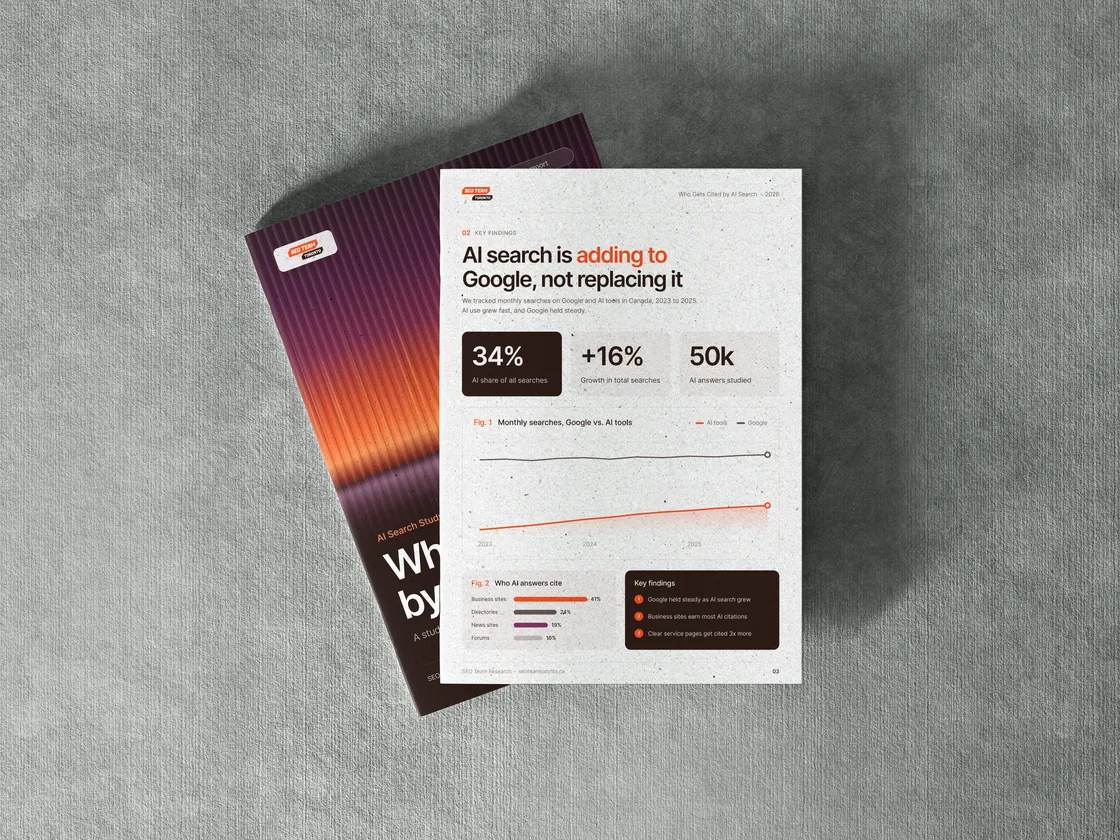





Google AI Mode changes the shape of a search result, but it does not make the fundamentals of SEO irrelevant.
Instead of showing only a ranked list of pages, AI Mode can research several parts of a question, assemble an answer, cite supporting sources, and let the user continue with follow-up questions. That creates a real traffic question for businesses: if Google can answer more of the query itself, when does someone still need to visit your website?
The answer depends heavily on search intent.
Simple informational searches are more exposed to zero-click behaviour. Complex purchases, professional services, local decisions, comparisons, pricing research, and other high-consideration searches can still create strong reasons to visit external sites.
The practical response is not to abandon SEO for a new set of AI tricks. It is to make your existing search strategy more useful, more evidence-driven, and more capable of answering the deeper questions AI Mode may retrieve.
At a glance:
- Google AI Mode is a conversational search experience that can research multiple subtopics before generating an answer.
- Google says its core Search quality and ranking systems still underpin AI Mode.
- There are no special AI schema requirements, proprietary AI files, or separate technical standards required for eligibility.
- Informational organic traffic faces greater pressure because some questions can be answered directly in Search.
- High-intent searches can still produce meaningful website visits when users need proof, reviews, pricing, credentials, comparisons, or a transaction.
- SEO measurement needs to expand beyond rankings to include AI visibility, branded demand, qualified traffic, conversions, and revenue.
What Is Google AI Mode?
Google AI Mode is an AI-powered Search experience designed for more complex, exploratory, and multi-part questions.
Instead of requiring you to run several individual searches, AI Mode can break a question into related subtopics, search for supporting information, synthesize a response, and provide links to relevant websites. Users can then ask follow-up questions without starting the research process again from scratch.
Google began rolling out AI Mode in English in Canada on August 21, 2025. In its Canadian launch announcement, Google described the experience as particularly useful for comparisons, trip planning, complex how-to questions, and other searches that previously required several separate queries.
The important distinction for businesses is that AI Mode is not simply a longer featured snippet. It changes how the research process itself can happen.
A traditional search might look like this:
- Search for a broad topic.
- Open several results.
- Return to Google.
- Refine the query.
- Open more pages.
- Compare what you found.
AI Mode can compress much of that exploration into one conversational search session.
That creates fewer guaranteed page visits during early research, but it also allows Google to surface sources that are highly relevant to specific parts of a broader question.
How Google AI Mode Actually Works
The exact ranking and generation systems behind AI Mode are not publicly disclosed. Google does, however, explain several important parts of the process.
The most useful concept for SEO teams is query fan-out.
Query Fan-Out
Query fan-out means Google can take one complicated question and issue multiple related searches across different subtopics.
Imagine someone searches:
What is the best accounting software for a 30-person Toronto SaaS company that bills in USD, needs Canadian tax support, and integrates with HubSpot?
A conventional keyword strategy might treat “best accounting software” as the main query.
AI Mode can interpret the question more broadly and investigate subjects such as:
- accounting software for SaaS
- Canadian tax functionality
- USD and CAD billing
- HubSpot integrations
- software pricing
- employee or user limits
- Canadian business reviews
- implementation complexity
A company does not necessarily need one page that perfectly matches the entire original sentence. A useful page answering one important sub-question may become relevant to part of the response.
That changes the unit of competition.
SEO has traditionally focused heavily on ranking one URL for one primary query. That still matters, but AI Mode gives businesses another reason to build strong topical coverage around the real decisions customers make.
Retrieval, Grounding and Synthesis
After breaking a question into related searches, Google can retrieve information from its Search systems and use those sources to construct a response.
Google's current guidance for AI features in Search says both AI Mode and AI Overviews can use query fan-out to find supporting pages. It also says the two experiences may use different models and techniques, which means they do not necessarily cite the same websites for the same topic.
This is important.
AI Mode is not simply generating an answer from a fixed internal knowledge base. Current web content can be retrieved and used to support parts of the response.
For SEO teams, that creates two separate questions:
- Is the page eligible to appear in Google Search?
- Is the page useful enough for the specific sub-question Google is trying to answer?
Technical eligibility gets you into the pool. Relevance, usefulness, authority, evidence, and fit determine whether your page has a realistic reason to be selected.
Google AI Mode vs. AI Overviews vs. Regular Search
AI Mode, AI Overviews, and traditional organic results all use Google's broader Search ecosystem, but the user experience is different.
The difference matters because visibility in one AI surface does not guarantee visibility in another.
An Ahrefs analysis of 730,000 response pairs found only 13.7% citation overlap between AI Mode and AI Overviews in the September 2025 U.S. dataset it studied. The responses were often semantically similar even though they drew on substantially different source URLs.
That does not mean there is a fixed 13.7% overlap across Google Search. AI results are dynamic, and Ahrefs measured one dataset at one point in time.
The more useful conclusion is that a brand should not treat an AI Overview citation as proof it has “won AI search.” Different Search experiences can use different sources to answer closely related questions.
Does Google AI Mode Reduce Organic Traffic?

It can, particularly for informational searches.
But there is no credible universal percentage that tells every business how much traffic AI Mode will remove. A blog answering a basic factual question, a local dentist page, an ecommerce category, and a B2B software comparison page do not face the same click behaviour.
The most useful data comes from looking at several studies separately.
What the Traffic Data Actually Shows
The Pew Research Center study examined 68,879 Google searches. Users clicked a traditional result in 8% of visits where an AI-generated summary appeared, compared with 15% of visits without one.
That is meaningful evidence of click pressure. It is also AI Overview evidence, not a direct measurement of Google AI Mode.
At the same time, a Semrush analysis of traffic channels found Google AI Mode itself was growing quickly during 2025 but remained a very small source of total website traffic. In Semrush's dataset, AI Mode traffic increased from about 1,600 visits in January to 38.2 million in December 2025, while still accounting for roughly 0.01% of total traffic.
There is another side to the picture.
A small UX study reported by Search Engine Land followed 52 participants in the U.S. and Canada as they used AI Mode for high-involvement service searches. Sixty-nine percent of those sessions resulted in a website visit.
The sample is too small to turn 69% into an industry benchmark. What it does show is that search intent can materially change user behaviour.
A person asking for a simple explanation may have little reason to click once the answer appears.
A person choosing a dentist, lawyer, software platform, contractor, consultant, or enterprise vendor still needs evidence that an AI-generated summary cannot fully provide.
Which Searches Are Most Exposed to Traffic Loss?
A useful way to assess risk is to ask two questions:
- Can Google satisfy the basic need directly in the search interface?
- Does the user still need to inspect an external source before acting?
That produces a simple traffic-risk framework.
An Anonymized Mini Example
Consider an anonymized composite of a Toronto B2B services company.
Its top-of-funnel article explaining a common industry acronym receives substantial search impressions. The visitor's basic question can be answered in a few sentences, so an AI-generated result reduces the need to visit the article.
The same company's commercial pages serve a different job. Prospects still need to review service scope, experience, examples, pricing approach, methodology, team credentials, and contact options before choosing a provider.
The lesson is not that informational content has become useless. Informational pages can still build authority, introduce a brand, earn citations, support internal links, and influence later demand.
The lesson is that traffic volume and business value need to be separated more carefully than before.
How Does Google Choose Sources for AI Mode?
There is no public checklist that guarantees an AI Mode citation.
Google does provide a much simpler answer to the eligibility question: a page must be indexed and eligible to appear in Google Search with a snippet. Google says there are no additional technical requirements for appearing as a supporting link in AI Mode or AI Overviews.
That makes conventional technical SEO foundational.
A page that cannot be crawled, is incorrectly canonicalized, blocked from indexing, buried behind poor site architecture, or otherwise ineligible for Search is not going to solve the AI visibility problem through a new content format.
Eligibility, however, is not the same as selection.
Once a page is available to Search, several practical qualities can improve its usefulness as a source:
- It answers a specific question clearly.
- The information is accurate and current.
- Claims are supported by evidence.
- The page demonstrates subject expertise.
- Important information is available in text, not hidden only inside an image or interface.
- The page addresses a meaningful subtopic rather than repeating generic summaries.
- The site's internal links help Google understand related content.
- Business and entity information is clear and consistent.
- Relevant third parties corroborate important claims or expertise.
This is where on-page SEO still matters.
Clear headings, direct answers, well-structured comparisons, descriptive internal links, relevant terminology, and strong intent alignment make content easier for people to understand and easier for Search systems to interpret.
That is different from writing mechanically for an AI crawler. The goal is clarity, not robotic formatting.
How to Make Your Site Competitive in Google AI Mode
The best AI Mode strategy starts with the same question as good SEO: why should this page be selected over another page that addresses the same need?
A practical audit can be organized into seven parts.
1. Confirm Crawl and Index Eligibility
Start with the technical foundation.
Check:
- indexability
- canonical tags
- robots directives
- internal linking
- rendering
- mobile accessibility
- page speed and usability
- XML sitemaps where relevant
- Search Console indexing data
Do not begin an AI readiness project by rewriting content that Google cannot reliably access.
2. Match the Real Intent Behind the Query
A page targeting “CRM software” should not automatically become a 5,000-word definition of CRM.
Determine what users actually need to decide. They may care about pricing, integrations, use cases, migration, security, alternatives, support, or implementation.
AI Mode's ability to fan out across subtopics makes shallow keyword targeting less defensible.
Build pages around complete decision needs.
3. Make Important Answers Easy to Find
A reader should not need to work through six paragraphs before discovering the central answer.
Use:
- descriptive headings
- short definitions
- comparison tables
- numbered processes
- direct summary paragraphs
- clear product or service details
- useful FAQ sections
This improves readability regardless of whether the page is eventually used in an AI-generated answer.
4. Add Information That Is Not Commodity Content
Generic information is easier to summarize and easier to replace.
Stronger content marketing can include:
- original research
- first-hand observations
- anonymized client patterns
- proprietary frameworks
- process documentation
- useful calculations
- screenshots
- expert commentary
- Canadian market context
- real tradeoffs and limitations
The objective is information gain.
If your article contains nothing that could not be assembled from the first five competing pages, it has a weaker reason to be referenced.
5. Build Supporting Topic Coverage
Because one complex AI Mode question can trigger several related searches, a site benefits from credible supporting content around the core topic.
For example, a cybersecurity company may need separate resources covering:
- compliance
- incident response
- penetration testing
- ransomware
- cyber insurance
- SOC 2
- Canadian privacy requirements
- vendor evaluation
Do not create dozens of near-duplicate posts for every keyword variation. Build distinct pages where each one has a clear purpose.
6. Keep Entity Information Accurate
Structured data remains useful when it accurately describes visible page content, but it should be treated as structured information, not an AI citation switch.
The same principle applies to business information.
Names, locations, products, services, authors, credentials, prices, and other important facts should be consistent wherever they appear.
For local businesses, accurate Google Business Profile information, reviews, service details, and local relevance remain useful because AI-assisted search still relies on Google's broader information ecosystem.
7. Build Evidence Beyond Your Own Website
A company claiming to be an authority is different from a company that independent sources consistently recognize as one.
Relevant mentions, editorial links, partnerships, reviews, industry citations, directories, associations, and expert contributions can all help establish a clearer external footprint.
This is where off-page SEO and authority building continue to support the broader search strategy.
The goal is not manufactured mentions at scale. It is credible corroboration.
AI SEO Tactics You Do Not Need
AI search has created a new market for tactics that sound more specialized than they are.
Some may be useful in limited contexts. Others are being presented as requirements despite little evidence that Google needs them.
You Do Not Need Special AI Schema
Google explicitly says there is no special schema.org structured data required to appear in AI Overviews or AI Mode.
Use structured data when it accurately describes content and supports a valid search feature. Do not add markup simply because someone claims it makes a page “AI readable.”
You Do Not Need a Special AI Text File for Google Search
Google's documentation says publishers do not need to create new machine-readable files or AI text files to appear in its AI Search features.
That includes treating llms.txt as a requirement for Google AI Mode.
An organization may choose to experiment with emerging AI standards for other reasons, but that is different from saying Google requires them for AI Mode visibility.
You Do Not Need to Rewrite Every Paragraph for a Machine
Clear structure matters.
That does not mean every paragraph needs to become a 40-word answer block with repetitive headings and unnatural phrasing.
Write for humans first. Make individual sections coherent enough to stand on their own, but preserve normal editorial flow.
You Do Not Need a Separate “GEO” Site
Creating one conventional website for people and another supposedly optimized for generative engines creates unnecessary complexity and can fragment authority.
Good AI readiness should improve the same content and infrastructure used for organic Search.
The fundamentals are still recognizably SEO:
- accessibility
- crawlability
- useful content
- intent
- internal links
- evidence
- authority
- accurate entities
- measurement
The interface has changed. The requirement to be a useful source has not.
How to Measure AI Mode Visibility and Traffic

Traditional SEO reporting often focuses on rankings, impressions, clicks, sessions, and conversions.
Those metrics still matter. AI search adds another layer between being visible and receiving a click.
A useful measurement model has four levels.
Level 1: Search Visibility
Track whether your pages are appearing across the search ecosystem.
Look at:
- Search impressions
- landing pages
- query groups
- branded versus non-branded visibility
- device
- geography
- generative AI impressions where available
Google announced dedicated Search Generative AI performance reports in Search Console on June 3, 2026. The report is being rolled out to a subset of websites and can show generative AI impressions, pages, countries, devices, and dates.
AI Mode activity is also included in overall Search Console Search performance totals.
That means teams should check what reporting is actually available in their property before assuming they have complete AI attribution.
Level 2: AI Citations and Mentions
Track representative prompts and topics that matter to the business.
Questions may include:
- Does the brand appear?
- Which competitors appear?
- Which URLs are cited?
- Which third-party sources influence the response?
- Is visibility stable across repeated tests?
- Which topics consistently exclude the brand?
Treat this as directional competitive research, not a perfect rank tracker.
Generated responses can change between searches. One citation screenshot does not establish a durable position.
Level 3: Qualified Website Behaviour
Do not stop at raw organic sessions.
Track what visitors actually do after arriving:
- engaged sessions
- product views
- service-page visits
- calls
- form submissions
- demo requests
- purchases
- newsletter signups
- assisted conversions
A reduction in low-intent visits can look severe in a traffic graph while having a smaller effect on pipeline.
The reverse is also possible. If a business depends heavily on monetized informational pageviews, fewer clicks may have a direct financial impact.
Level 4: Commercial Outcomes
The final layer is business value.
For most B2B and service organizations, reporting should ultimately connect search activity to:
- qualified leads
- opportunities
- pipeline
- customer acquisition
- revenue
- cost per acquisition
- lifetime value
This produces a healthier question than “Did organic sessions go up?”
The better question is: Is search still helping the right people discover, evaluate, and choose the business?
What Toronto and Canadian Businesses Should Do Next

Canadian businesses do not need to rebuild their entire SEO program around Google AI Mode.
They do need to reassess which parts of organic search create value.
Start with the pages closest to revenue.
Make sure service, product, category, comparison, location, and conversion pages clearly explain what you offer, who it is for, why it is different, and what someone needs to know before acting.
Then audit informational content.
Ask:
- Is this page answering a question AI can now satisfy without a click?
- Does the page offer anything beyond the basic answer?
- Does it lead naturally to a deeper decision?
- Is there original evidence or experience?
- Does it support an important commercial topic?
- Is the traffic actually contributing to leads, revenue, links, brand demand, or authority?
Do not delete useful informational content simply because its CTR changes.
Instead, understand its role.
A strong educational article may still help a business become a cited source, earn links, strengthen a topic cluster, create branded awareness, or support prospects who encounter the company again later.
For Toronto and GTA businesses, local search deserves particular attention. Reviews, accurate business information, relevant service pages, local authority, and strong commercial proof become more important when AI is helping users assemble a shortlist before they visit individual websites.
That is a healthier response than trying to manufacture an “AI optimization” layer disconnected from the rest of the site.
Frequently Asked Questions About Google AI Mode
Is Google AI Mode Replacing Normal Search?
Google is integrating AI more deeply into Search, but businesses should not assume conventional organic results have disappeared.
Search experiences continue to vary by query, context, location, device, and user behaviour. Traditional results, AI-generated responses, local results, shopping features, video, and other formats can all be part of the broader search journey.
Does SEO Still Matter in Google AI Mode?
Yes.
Google says its existing SEO fundamentals remain relevant to AI Overviews and AI Mode. Pages still need to be crawlable, indexable, eligible for Search, useful, accurate, and relevant before they can realistically become supporting sources.
The practical work changes at the margins, but AI Mode does not remove the need for SEO.
Can Google AI Mode Reduce Organic Traffic?
Yes, particularly when a user's need can be satisfied directly by a generated answer.
Basic definitions, quick explanations, summaries, and simple informational queries face the greatest exposure. High-consideration, local, commercial, and transactional searches can still create strong reasons to visit a website.
Can My Page Appear in AI Mode Without Ranking Number One?
Potentially.
Google's query fan-out system can retrieve sources across related subtopics, and third-party studies show AI Mode citations can differ substantially from conventional or AI Overview source sets.
However, there is no guaranteed formula for inclusion. Strong organic eligibility and relevance remain the foundation.
Is AI Mode the Same as AI Overviews?
No.
AI Overviews generally provide generated summaries within Search results, while AI Mode is designed as a deeper conversational experience with follow-up questions and broader exploration.
The two systems can also use different models, techniques, and supporting URLs.
Does Schema Help With Google AI Mode?
Structured data can help Google understand specific information on a page when it accurately reflects visible content.
However, Google says there is no special structured data required to appear in AI Mode. Schema should be implemented because it is correct and useful, not as an AI citation shortcut.
Can I Track AI Mode in Google Search Console?
AI Mode activity counts toward Google Search Console's overall Search performance reporting.
Google has also begun rolling out dedicated generative AI performance reports to a subset of sites. Availability can vary, so teams should confirm what their individual Search Console property currently provides.
Is Google AI Mode Available in Canada?
Yes.
Google began rolling AI Mode out in English in Canada on August 21, 2025. The product has continued to evolve since then, so businesses should expect the interface, capabilities, and reporting around AI Search to keep changing.
Google AI Mode changes how people research, but the right response is measured. Build a site that Search can access, publish information worth retrieving, understand which queries still create commercial intent, and measure performance beyond raw traffic.
If you want to assess how prepared your site is for AI-driven Search without replacing sound SEO fundamentals with unsupported tactics, learn more about our AI Readiness services.