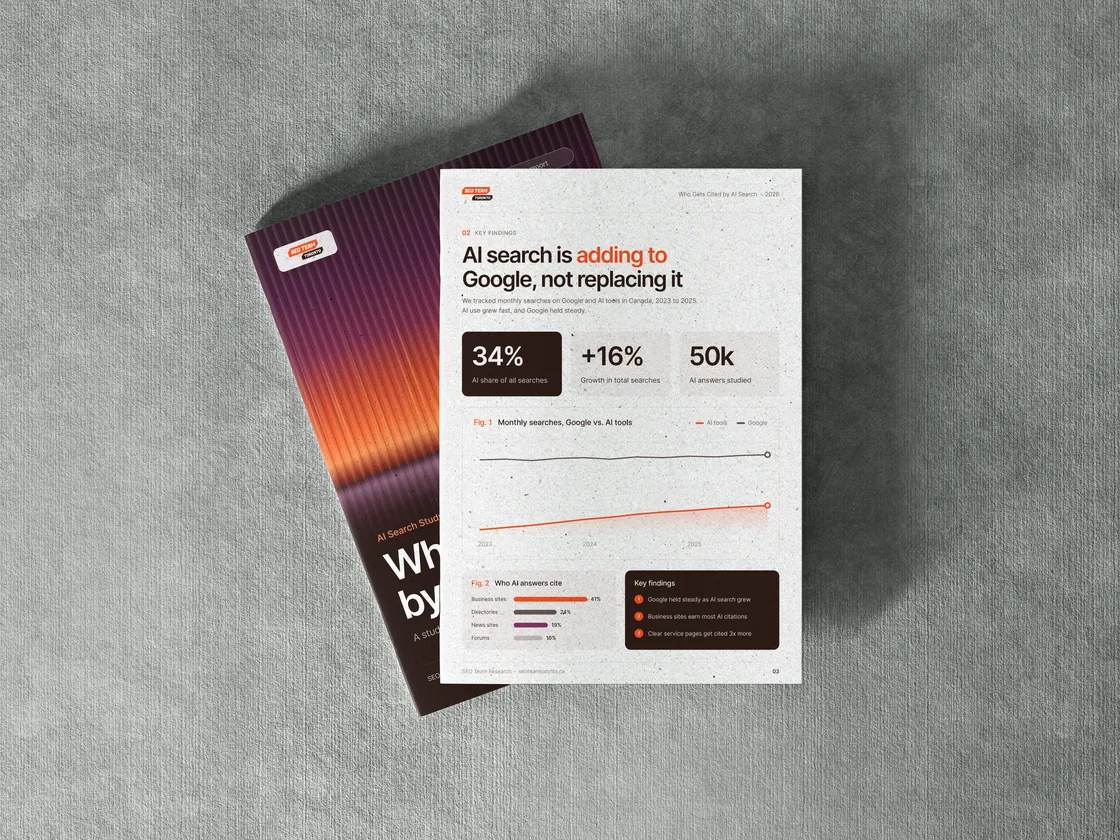





GEO, AEO and SEO are often presented as three separate disciplines. The reality is less tidy.
SEO, or search engine optimization, is still the foundation. AEO, or answer engine optimization, is a useful term for improving the chances that your information becomes part of a direct answer. GEO, or generative engine optimization, focuses more specifically on how brands, websites and information appear inside AI-generated responses.
The important distinction is not the acronym. It is the type of search experience being optimized, how information is retrieved, and what success looks like once the user may receive an answer without clicking a traditional result.
Google has made its own position unusually clear. In its current guidance on optimizing for generative AI search, Google describes AEO and GEO as industry terms but says that, from its perspective, optimizing for generative AI features in Google Search is still SEO. Its AI features remain rooted in Google's core Search ranking and quality systems.
That does not mean nothing has changed. It means businesses should separate genuine changes in search behaviour and measurement from familiar SEO work being sold under a new label.
What Is SEO?
Search engine optimization is the practice of improving a website so search systems can discover, understand and surface its information for relevant searches.
Modern SEO is broader than ranking a page in a list of blue links. It includes technical accessibility, page relevance, search intent, internal architecture, useful content, external authority, local signals and the search experience a visitor reaches after clicking.
A strong SEO program generally covers four connected areas:
- Technical accessibility: Can search systems crawl, render and index the content?
- Relevance: Does the page clearly address the searcher's intent?
- Information quality: Does the content provide useful, accurate and differentiated information?
- Authority and trust: Are there credible signals that support the website, organization or claims being made?
This is why a sound technical SEO foundation remains important as search becomes more generative. Google says pages considered for its generative AI features still need to meet the technical requirements for Google Search, including being indexed and eligible to appear with a snippet.
SEO therefore remains the underlying infrastructure. The output surface may change, but search systems still need to find and understand the source.
What Is AEO?
AEO stands for answer engine optimization.
The term is generally used to describe work intended to help information appear as a direct answer rather than only as a conventional search listing. Depending on who is using the term, that can include featured answers, voice search, AI-generated summaries and conversational assistants.
There is no universal technical standard called AEO.
In practice, good answer-oriented content tends to do several familiar things well. It identifies a clear question, answers it accurately, provides enough context to establish meaning, and structures the surrounding page so readers can understand the larger topic.
For example, consider the query:
How long does SEO take?
A traditional organic result might earn a ranking for a comprehensive guide. An answer-oriented system might instead extract or synthesize a concise explanation such as: SEO commonly requires months rather than days, with timing depending on site condition, competition, authority and execution.
Those outcomes are different, but much of the work underneath them is not.
Clear on-page SEO, intent alignment and useful explanations can support both. What changes is the way the information is surfaced and consumed.
This is one reason we would not treat AEO as a replacement for SEO. It is better understood as a useful lens for answer-focused search experiences.
What Is GEO?
GEO stands for generative engine optimization.
The term became more formalized through the 2024 research paper “GEO: Generative Engine Optimization”, published in the proceedings of the ACM SIGKDD conference. The researchers described generative engines as systems that synthesize information from multiple sources and introduced a framework for measuring and improving source visibility inside generated answers.
In its benchmark experiments, the research found that certain optimization approaches could improve source visibility by up to 40%. That figure needs context. It describes results within the researchers' experimental framework, not a guaranteed uplift that businesses should expect from a GEO campaign.
In current marketing use, GEO usually refers to improving how a website or brand appears across generated responses. That can include:
- Being selected as a supporting source
- Receiving a visible citation
- Having the brand named in the generated answer
- Being represented accurately
- Appearing consistently across relevant conversational prompts
- Increasing visibility relative to competitors
This is where generative vs traditional search starts to matter.
A conventional search result usually asks the user to choose among sources. A generative system may retrieve information from several sources, combine it, summarize it and present an answer before the user decides whether to visit any of them.
GEO is therefore partly about content visibility and partly about representation.
GEO vs AEO vs SEO: The Differences That Actually Matter
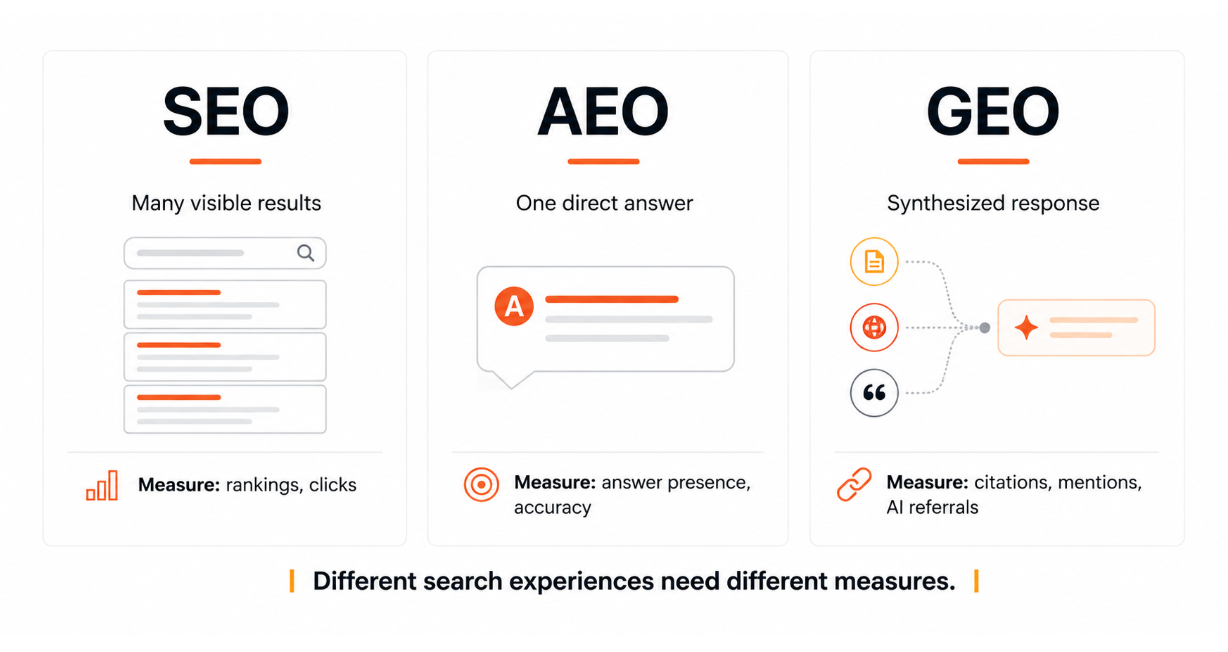
The practical differences become clearer when we stop comparing acronyms and compare the search experiences themselves.
The Search Surface
Traditional SEO often focuses on visible search results: pages, products, local listings, videos or other search features.
AEO focuses more directly on whether information can satisfy an answer-oriented experience.
GEO deals with systems that may assemble a new response from several retrieved or learned sources.
The Unit of Success
With traditional SEO, teams often track a URL.
For example:
- Did the URL rank?
- How many impressions did it receive?
- Did users click?
- Did those visits convert?
With answer and generative search, the unit becomes less straightforward.
A brand could be mentioned without receiving a link. A page could be cited without the brand being named. A website could influence the answer while generating little direct referral traffic.
A 2026 Semrush study on AI citations and brand mentions illustrates the distinction. In its dataset, 61.7% of analyzed appearances were what Semrush called “ghost citations”: the page appeared as a source, but the brand itself was not named in the answer.
That means citation, mention and recommendation should not be treated as the same metric.
User Behaviour
Traditional search usually expects a choice. The user scans results, evaluates options and clicks one.
Generative search can move part of that evaluation into the result itself.
Pew Research Center analyzed 68,879 Google searches made by U.S. adults in March 2025. Users clicked a traditional search result in 8% of visits when an AI summary was present, compared with 15% when one was not. Links within the AI summary itself were clicked in 1% of visits with a summary. Pew's analysis does not tell us what every future search journey will look like, but it shows why visibility and traffic can no longer be treated as interchangeable measures.
Attribution
Classic web analytics is built around visits.
Generative search creates a more complicated attribution problem because a user may learn about a company from an AI response, remember the name, and later arrive through branded search, direct traffic or another channel.
That makes GEO measurement less precise than traditional rank and traffic reporting.
Measurement
The disciplines therefore emphasize different reporting layers:
- SEO: rankings, impressions, clicks, conversions
- AEO: answer presence, source visibility, answer accuracy
- GEO: citations, mentions, competitive share of voice, representation accuracy and AI referrals
These measurements should complement each other rather than compete.
Where SEO, AEO and GEO Overlap
The overlap is much larger than many comparison articles imply.
All three depend, to varying degrees, on information being accessible, understandable, useful and credible.
For Google in particular, the connection is explicit. Google's generative Search systems use techniques such as retrieval-augmented generation, or grounding, that rely on Search systems to retrieve relevant information. Google also uses query fan-out, where a model may issue several related searches to gather information needed for a more complete response.
That keeps several familiar priorities in place:
- Crawlable and indexable pages
- Clear site architecture
- Accurate information
- Strong alignment with user needs
- Original analysis and first-hand expertise
- Descriptive headings and useful organization
- Relevant internal links
- Credible third-party authority
- A usable page experience
Google's broader people-first content guidance also emphasizes original information, substantial value, expertise and a satisfying experience rather than content created mainly to manipulate search visibility.
For businesses, this is an argument for investing in genuinely useful content marketing, not producing separate batches of “SEO content” and “AI content” that say the same thing in slightly different formats.
The better question is whether the underlying information deserves to be retrieved in the first place.
What Is Genuinely New About AI Search?
If so much of GEO overlaps with SEO, what has actually changed?
Several things.
Query Fan-Out Expands the Retrieval Problem
A traditional keyword strategy often starts with the visible query.
Generative systems can go further. Google's own documentation describes query fan-out, where related searches are generated to gather information needed to answer the original question.
That makes topical clarity more important than creating a page for every exact wording.
A company answering one broad commercial question may need strong information around the supporting concepts that a system could retrieve while constructing its answer.
Generated Answers Synthesize Multiple Sources
A page no longer needs to be the only destination to influence the result.
An AI answer may synthesize:
- A company's own website
- Editorial publications
- Reviews
- directories
- forums
- videos
- government information
- product data
- other third-party sources
That increases the value of consistency across the web.
It also gives off-page SEO and digital authority another role. Mentions and citations are useful when they are genuine because they help establish a broader body of evidence about an organization. They should not be manufactured simply to create the appearance of popularity.
Visibility Is Less Deterministic
Traditional rankings already vary by location, device, personalization and SERP layout.
Generated responses add another layer of variation. The wording of a prompt, conversation history, model version, retrieval process and available sources can all affect what appears.
This makes checking one prompt once a weak measurement method.
Citation Is Not the Same as Commercial Visibility
A source link can support a factual statement while leaving the source brand nearly invisible.
Conversely, a brand may be mentioned without its website being cited.
That distinction is genuinely important for GEO. Businesses need to know whether they are functioning as invisible research material, visible authorities, recommendations, or actual traffic destinations.
Do You Need Separate GEO or AEO Work?
Sometimes. But first separate new work from renamed work.
We use a simple three-layer model:
1. Foundation
Can search and retrieval systems reliably access and understand the business?
This includes:
- Technical SEO
- Indexability
- Canonicals
- Site architecture
- Search intent
- Content quality
- Internal linking
- Core authority signals
If the foundation is weak, calling the next layer GEO will not solve it.
2. Retrieval and Representation
Can systems find enough clear, credible information to represent the organization accurately?
Review:
- Entity and business information consistency
- Clear descriptions of products and services
- Expert evidence
- Original research or experience
- Third-party references
- Reviews and reputation
- Factual consistency across important sources
This is where some AI-readiness work becomes distinct from a conventional ranking project.
3. Measurement
Can the organization tell whether AI visibility is creating value?
Track:
- Search visibility
- Generative search impressions
- Citations
- Brand mentions
- Competitive share of voice
- Representation accuracy
- AI referral traffic
- Leads, revenue and assisted conversions where measurable
A Practical Decision Tree
Use this sequence before creating a separate AEO or GEO budget:
- Is the site technically healthy and competitive in traditional search?
If no, prioritize SEO fundamentals. - Does the site contain useful, differentiated information that deserves to be retrieved?
If no, improve the information itself. - Is the business represented consistently across its website and credible third-party sources?
If no, strengthen entity and authority signals. - Are relevant AI systems failing to cite, mention or represent the brand despite a strong foundation?
If yes, targeted AI-readiness work may be justified. - Can the business measure whether that visibility matters commercially?
If no, improve measurement before expanding the budget.
This approach prevents the same technical, content and authority work from being purchased twice under different labels.
How Should SEO, AEO and GEO Be Measured?

Measurement is one of the areas where AI search creates legitimate new work.
Google itself has started separating some of this visibility. In June 2026, Google announced generative AI performance reports in Search Console, with dedicated reporting for impressions in features such as AI Overviews and AI Mode. The initial rollout was limited to a subset of sites.
A useful reporting structure looks like this:
Layer
Metrics to Watch
Traditional SEO
Rankings, non-brand impressions, organic clicks, CTR, leads, revenue
Answer Visibility
Answer presence, cited URL, factual accuracy
Generative Visibility
Citation rate, brand mention rate, share of voice, representation accuracy
Business Impact
AI referrals, branded demand, assisted conversions, qualified leads
The important rule is to avoid turning a new metric into a vanity metric.
For example, “we appeared in 47 AI answers” provides little value without context. Which prompts mattered? Were competitors appearing more often? Was the company represented accurately? Was it merely cited as background evidence, or was it actually named as a relevant option?
A mature GEO report should make those distinctions visible.
GEO and AEO Myths Businesses Should Ignore
AI search has created useful new questions. It has also created a market for tactics that sound more settled than they are.
None of this means structured data, clear writing or useful headings have stopped mattering.
It means the reason for using them matters. Structured data can still support relevant rich-result eligibility. Short answer paragraphs can still make information easier for people to understand. Clear headings still improve navigation.
The mistake is turning good web practices into invented AI requirements.
Practical GEO/AEO Vendor Checklist
Before approving a separate AI-search proposal, ask:
- Which work is genuinely new versus already included in our SEO program?
- Which search or AI platforms are being targeted?
- How will citations and brand mentions be measured separately?
- How will prompt volatility be handled in reporting?
- What evidence supports each recommended tactic?
- Are any claimed requirements contradicted by official platform guidance?
- How will factual accuracy and representation errors be monitored?
- What business outcome will determine whether the program is worth continuing?
If those questions cannot be answered clearly, the problem is probably not the acronym.
What This Means for Toronto and Canadian Businesses

Most Canadian businesses do not need three independent search strategies.
They need one strong search foundation and a clear view of how customers are discovering information across increasingly varied surfaces.
Consider a simplified anonymized scenario.
A Toronto professional-services firm has technically sound pages and earns reasonable organic visibility for its core services. Yet when common research prompts are tested across generative systems, the firm is inconsistently described and rarely included alongside established competitors.
The first response should not be to publish dozens of “GEO articles.”
An audit might instead examine whether:
- Service descriptions are consistent across the website
- Key expertise is demonstrated rather than asserted
- Business facts are accurate across important listings
- Third-party profiles reflect the same positioning
- Relevant publications or industry sources mention the firm
- Reviews provide credible evidence about actual services
- Important claims can be corroborated elsewhere
For a local business, the same principle applies to location information. The website, Google Business Profile and reputable listings should not disagree about names, services, addresses, service areas or operating details.
That makes local SEO part of the broader AI-readiness picture when location matters.
The goal is not to manufacture a version of the company for AI systems. It is to make the real company easier to discover, verify and represent accurately.
The Bottom Line: Think One Search Strategy, Multiple Surfaces
SEO, AEO and GEO are different enough to be useful terms, but not different enough to justify treating them as three disconnected foundations.
SEO remains the core discipline. It makes information accessible, relevant and competitive.
AEO focuses attention on whether that information can directly satisfy a question.
GEO focuses attention on what happens when generative systems retrieve, combine and represent information from multiple sources.
The biggest changes are therefore not a new set of magic formatting rules. They are changes in retrieval, attribution, multi-source visibility, user behaviour and measurement.
Businesses should protect the fundamentals first, then add AI-specific monitoring and optimization where there is evidence that customers are using those surfaces.
For teams deciding what that should look like in practice, our AI Readiness services focus on strengthening search fundamentals, evaluating AI visibility, and identifying the work that is genuinely different rather than renaming existing SEO.