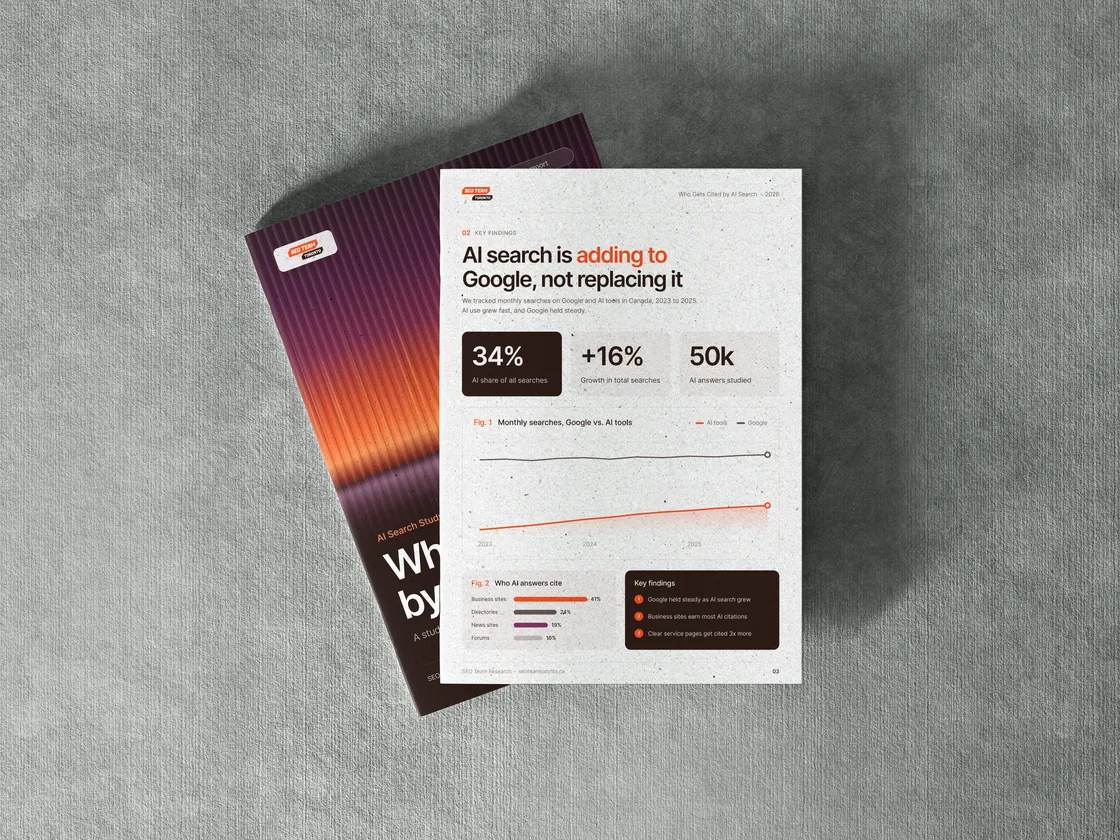






Getting your business mentioned in ChatGPT is not about finding a hidden ranking factor or adding a few lines of AI-specific code to your website. There is no guaranteed position in ChatGPT, and the system can produce different answers depending on the question, context, location, available web sources, and other factors.
What businesses can do is improve the conditions that make their brand and content easier to discover, understand, verify, cite, and recommend.
A practical ChatGPT SEO strategy comes down to four layers:
- Technical eligibility: ChatGPT must be able to access relevant public content when web search is involved.
- Clear, useful information: Your website needs content that answers real questions and states important business facts clearly.
- Third-party corroboration: Other credible sources should confirm that your business exists, operates in its category, and is worth considering.
- Measurement: You need a repeatable way to track mentions, citations, referrals, and commercial outcomes.
That framework is more useful than trying to optimize for a single prompt. ChatGPT visibility is better understood as a pattern across many related questions.
Can You Make ChatGPT Mention Your Business?
You can improve your chances of being discovered and cited in ChatGPT, but you cannot force or guarantee a mention. OpenAI states in its ChatGPT Search documentation that ranking uses multiple factors intended to surface reliable and relevant information, and there is no way to guarantee top placement.
For most businesses, the highest-priority actions are straightforward:
- Make sure ChatGPT Search can access your site.
- Publish clear, useful pages around the questions customers actually ask.
- Keep important business facts consistent across the web.
- Earn credible third-party mentions in places your audience already trusts.
- Maintain structured product and business information where applicable.
- Track visibility across a set of prompts rather than checking one question once.
This overlaps heavily with conventional SEO. The difference is that AI assistants can combine information from multiple sources into a single answer, which makes off-site brand evidence and extractable content especially important.
ChatGPT Mentions, Citations, and Rankings Are Not the Same Thing
Before trying to “rank in ChatGPT,” define what success means.
A brand mention occurs when ChatGPT names your company in the generated answer. A citation occurs when your website is referenced as a source. A referral occurs when someone follows that source link to your website.
These outcomes can happen independently.
A 2026 Semrush study of AI citations and brand mentions analyzed 3,981 domain appearances across several AI search systems. It found that 61.7% of observed citations were “ghost citations,” where the source appeared but the brand name did not. Within its ChatGPT sample, citation rates were considerably higher than explicit brand-mention rates.
For a business, the practical conclusion is simple: do not use citations as your only AI visibility KPI.
How Does ChatGPT Find Businesses and Sources?
ChatGPT does not rely on one single discovery mechanism for every response.
Existing Model Knowledge
Some answers can be produced from information the model already has available without conducting a fresh web search.
That means a business with a broad, consistent public footprint may sometimes be mentioned without receiving a live citation in the answer. Marketers cannot directly edit or control that underlying model knowledge.
This is one reason brand visibility is broader than technical website optimization alone.
Live ChatGPT Search
ChatGPT can also search the web when current or source-backed information is useful.
OpenAI explains that ChatGPT Search may rewrite a user's question into one or more targeted searches that are sent to search providers. That means your page does not necessarily need to repeat the exact wording of every possible conversational prompt.
Research also suggests that web search is not triggered for every interaction. Semrush's 17-month ChatGPT traffic analysis found that web search was active on 34.5% of queries in its February 2026 clickstream sample. The same study found outbound referral traffic from ChatGPT grew 206% year over year from January 2025 to January 2026.
The exact percentage can change as the product evolves, but the broader point remains: businesses need both strong web content and a credible brand footprint beyond their own website.
Product and Shopping Retrieval
Commerce introduces another layer.
When someone asks ChatGPT for products, comparisons, or buying recommendations, structured merchant and product data may help shape the results. This requires a somewhat different strategy from trying to get a service business cited in an informational answer.
We cover that separately below.
Step 1: Make Your Website Eligible for ChatGPT Search
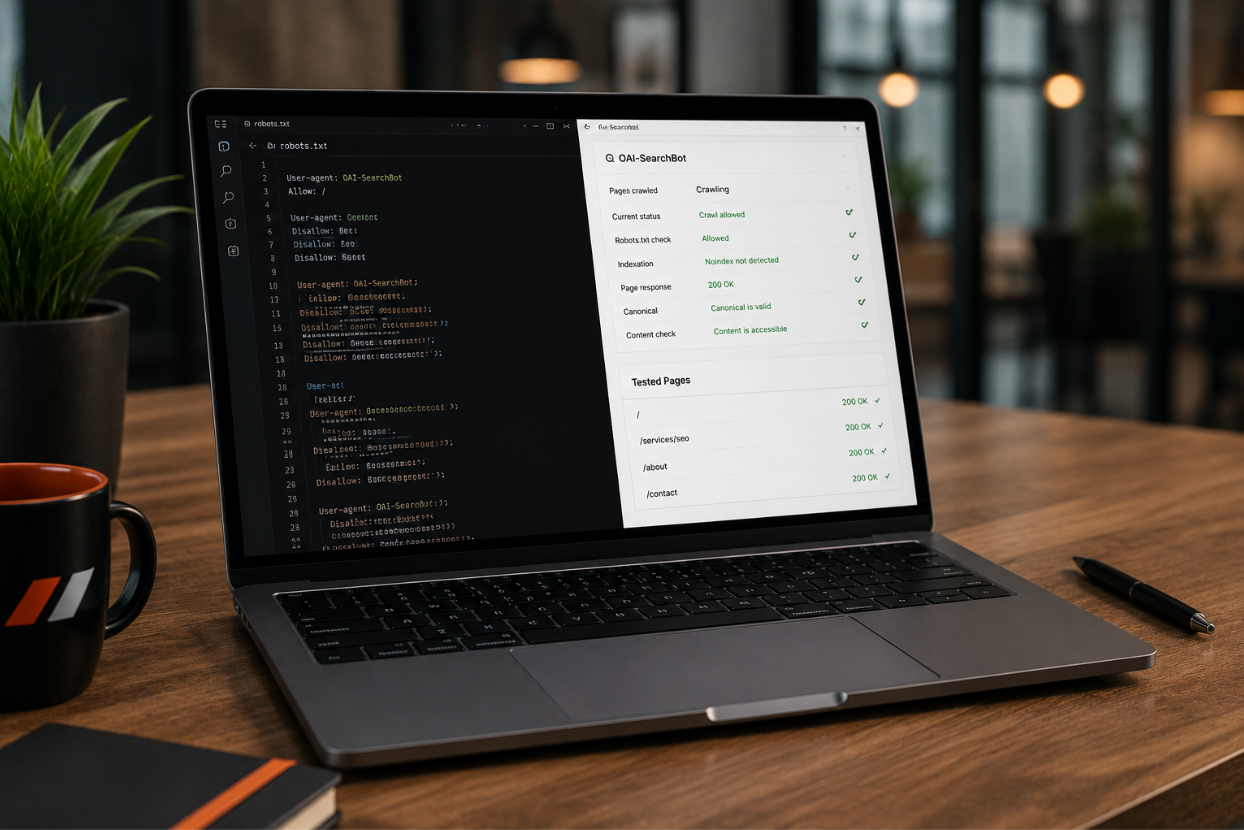
The first task is technical. If OpenAI's search crawler cannot properly access your website, stronger copy or more backlinks will not solve the underlying problem.
OpenAI's current publisher and developer guidance says sites that want content included in ChatGPT Search summaries and snippets should not block OAI-SearchBot. OpenAI also publishes IP ranges that hosts and content delivery networks can allow.
A useful technical check includes:
- Review robots.txt for rules affecting OAI-SearchBot.
- Check whether your CDN or web application firewall challenges or blocks OpenAI traffic.
- Confirm important pages return a normal HTTP 200 response.
- Remove accidental noindex directives from pages that should be discoverable.
- Check canonical tags for important commercial and informational pages.
- Confirm meaningful content is available in the rendered page.
- Avoid hiding essential information behind login walls or interactions that crawlers cannot access.
Do not confuse OAI-SearchBot with every other OpenAI crawler. Different OpenAI user agents can serve different purposes, and allowing one should not be presented as a guaranteed path to ChatGPT citations.
For businesses with complicated crawling, rendering, canonical, or indexation issues, this belongs within a broader technical SEO audit, not as a standalone AI fix.
Step 2: Make Your Content Easy to Understand, Verify, and Cite
Once the site is accessible, the next question is whether the content is worth using.
AI search does not create a reason to abandon good content principles. It raises the value of clarity.
Answer the Question Early
If a section promises to explain how long SEO takes, what a service costs, or how a process works, answer that question near the beginning of the section.
Do not make readers move through several paragraphs of context before reaching the useful information.
A stronger pattern is:
Direct answer → supporting explanation → evidence → caveat or next step
That structure works for people scanning a page and for systems extracting a concise passage.
Support Claims With Evidence
A source-worthy page should make it easy to distinguish facts from assertions.
For important statistics, benchmarks, regulations, or platform behaviours:
- Name the source.
- Link to the original source where possible.
- Include the relevant year or date.
- Avoid citing a third-party article that merely cites another article.
- Update claims when the underlying source changes.
Original information can be especially valuable. This might include first-party survey data, a documented methodology, an internal benchmark, or a clearly labelled practitioner observation.
Google gives similar advice for its own AI search experiences. Its guidance for succeeding in AI search emphasizes unique, useful content, strong page experience, crawlable pages, and structured data that matches visible information. It does not recommend abandoning standard SEO for a separate set of AI tricks.
Make Important Entities Explicit
Do not make the reader infer who you are, what you sell, or where you operate.
A service business should state clearly:
- Business name
- Core services
- Relevant industries
- Locations or service areas
- Credentials where applicable
- Key people or authors
- Pricing or engagement model where appropriate
- Contact and company information
The same principle applies within articles. If a paragraph could be pulled out of context, it should still be clear what product, company, process, or concept it describes.
Use Structured Data Correctly
Relevant structured data may include:
- Organization
- LocalBusiness
- Product
- Article
- Breadcrumb
- Person or author information where appropriate
Structured data should reflect what users can actually see on the page.
It can help machines interpret content consistently, but it should not be framed as a direct switch for ChatGPT citations. Schema supports clarity. It does not replace useful content or credible external evidence.
A strong content marketing strategy should therefore focus on building genuinely useful topic coverage rather than simply adding AI-oriented markup.
Step 3: Build Third-Party Evidence That Your Brand Belongs in the Answer
Your own website can explain what your company does. Other websites help confirm it.
For ChatGPT SEO, this makes off-site visibility important in a slightly different way from conventional link acquisition.
Relevant third-party evidence can include:
- Industry publications
- News coverage
- Expert interviews and quotations
- Independent product or service reviews
- Comparison articles
- Professional associations
- Reputable business directories
- Relevant YouTube coverage
- Authentic discussions in communities and forums
The goal is not to manufacture mentions everywhere. It is to appear in credible contexts where your category, products, expertise, or customer use cases are already being discussed.
Ahrefs analyzed 75,000 brands and found that branded web mentions correlated strongly with visibility across ChatGPT and Google's AI search experiences. YouTube mentions had the strongest correlation among the factors it studied. Ahrefs also explicitly notes that correlation does not establish causation. (See the Ahrefs study.)
Its July 2026 dataset also found Reddit was the most-cited domain among the leading ChatGPT sources it tracked in the United States. That does not mean businesses should create fake accounts or seed manufactured recommendations. It means authentic community discussion can be an important source type in conversational search. (See the citation dataset.)
A sensible off-page SEO strategy should prioritize legitimate authority and relevant brand coverage, not raw mention volume.
Step 4: Build Topic Authority Instead of Publishing Prompt Spam
A common mistake is to take every slightly different ChatGPT prompt and turn it into a separate page.
For example:
- best accounting software for agencies
- best accounting software for small agencies
- best accounting software for marketing agencies
- best accounting platform for digital agencies
If each page says essentially the same thing, publishing all four creates little information gain.
Instead, organize content around the buyer's actual topic.
A strong topic cluster might include:
- A clear category guide
- A comparison page
- Pricing or cost guidance
- Use cases
- Alternatives
- Implementation guidance
- Original research or benchmarks
- Relevant FAQs within substantive pages
This produces useful coverage while avoiding hundreds of near-duplicate pages.
Recent Semrush research supports measuring AI visibility this way. Its 2026 study of 50,000 brands found that appearing for one prompt did not mean a brand consistently appeared for related questions in the same topic. Only 15.2% of the categories it analyzed had a clear brand owner under its methodology.
For planning purposes, think in prompt clusters, not individual prompt rankings.
A simple decision tree helps:
Does this new page answer a genuinely different customer need?
- Yes: build the page if you can add substantial unique value.
- No: strengthen the existing page instead.
- Unsure: compare the intended answer, audience, evidence, and conversion goal. If all four are nearly identical, a separate page probably is not justified.
Step 5: Make Local Business Information Consistent
Local recommendations depend heavily on clear, accurate business information.
For a local company, check consistency across:
- Your website
- Google Business Profile
- Major business directories
- Industry-specific directories
- Professional associations
- Review platforms
- Publisher profiles
- Social and video profiles where relevant
Core facts such as business name, address, phone number, service area, categories, hours, and website should not contradict one another.
A Toronto contractor, for example, should not describe itself as a Toronto-wide company on its website, list only a Mississauga service area on one major directory, and use an outdated Scarborough address elsewhere.
Mini Example: Cleaning Up Conflicting Local Signals
Consider a composite example based on common local SEO audit patterns.
A Toronto professional-services company has a well-designed website and several strong reviews, but third-party profiles use two variations of the company name, an old phone number remains on one directory, and the website never clearly explains which GTA markets it serves.
The first priority would not be publishing ten new “ChatGPT SEO” articles. It would be correcting the entity information, clarifying location and service pages, updating major profiles, and then testing relevant recommendation prompts over time.
That work is part of a wider local SEO strategy, and it also makes the business easier for search and AI systems to interpret consistently.
Step 6: If You Sell Products, Optimize for ChatGPT Shopping Separately
E-commerce brands need to think beyond informational citations.
OpenAI's ChatGPT Shopping documentation says product selection can use structured information from first-party and third-party sources, including details such as product descriptions, prices, reviews, and availability. Product results are selected separately from advertising.
Important product data includes:
- Accurate product titles
- Detailed descriptions
- Current price
- Availability
- Variants
- Images
- Review data
- Merchant information
- Shipping or fulfilment details where supported
For Shopify merchants, OpenAI says Shopify Catalog product data is integrated into ChatGPT product discovery. OpenAI also supports other merchant data paths through its commerce infrastructure.
The practical priority is data quality. If price, availability, product names, or variants are inconsistent across feeds and landing pages, adding more editorial copy is unlikely to solve the underlying commerce problem.
Retailers should treat this as part of their broader e-commerce SEO and product-data strategy.
How to Measure Whether Your ChatGPT SEO Is Working
Checking one prompt manually is not a measurement system.
ChatGPT outputs can vary, and closely related prompts can produce different brands and sources. A useful measurement framework should therefore track a stable set of commercial questions over time.
1. Build a Prompt Set
Start with 20 to 50 questions that represent real buyer behaviour.
Include several types:
- Category questions
- Comparison questions
- “Best” or recommendation questions
- Alternative queries
- Cost and pricing questions
- Problem-based questions
- Local questions
- Product questions where applicable
For example, a Toronto cybersecurity company might track both “cybersecurity companies in Toronto” and more specific questions such as “cybersecurity firms for Canadian financial services companies.”
2. Track Brand Mention Rate
Measure how often your company is explicitly named.
If your brand appears in 8 of 40 relevant prompts, your observed mention rate for that test set is 20%.
The number is not an absolute market share. Its main value is consistency over time.
3. Track Citation Rate
Record which prompts cite your domain, which pages are cited, and which competitors' domains appear.
A strong cited page may reveal something worth expanding. A competitor citation may identify a publisher, comparison page, or content format you have not addressed.
4. Track Source Gaps
Look beyond your own rankings.
Ask:
- Which publishers are repeatedly cited?
- Which review sites appear?
- Which directories appear?
- Which competitors are frequently mentioned?
- What topics surround those mentions?
- Is the cited source one you could legitimately contribute to, be reviewed by, or earn coverage from?
This turns AI visibility research into a practical PR, content, and authority plan.
5. Track Referral Traffic and Commercial Outcomes
OpenAI notes that sites allowing OAI-SearchBot can track ChatGPT referral traffic in analytics platforms.
Monitor:
- Referral sessions
- Engaged visits
- Leads
- Assisted conversions
- Revenue
- Lead quality
Mentions are useful only to the extent that they contribute to discovery, trust, qualified traffic, or sales.
ChatGPT SEO Tactics That Are Overhyped or Misunderstood
AI search is developing quickly, which creates room for claims that move faster than the evidence.
“We Can Guarantee You a Top ChatGPT Ranking”
No credible provider can guarantee a fixed top position across ChatGPT responses.
OpenAI itself says top placement cannot be guaranteed.
“Schema Markup Gets You Cited”
Schema can make information clearer and more machine-readable. That is useful.
It is not a guaranteed citation mechanism.
“Publish Hundreds of AI-Written FAQ Pages”
More pages do not automatically create more authority.
If hundreds of pages provide nearly identical answers, they create duplication and maintenance costs without necessarily helping users.
“Just Change the Date to 2026”
Freshness matters when the information itself changes.
Updating a publication date while leaving stale statistics, screenshots, pricing, recommendations, or product information untouched does not make a page meaningfully current.
“More Backlinks Automatically Mean More ChatGPT Mentions”
Links remain important to conventional SEO and online authority, but current AI visibility research shows a more complicated relationship.
Ahrefs' correlation research found broad branded web mentions were more closely associated with AI visibility than raw backlink volume in its dataset. That does not make links irrelevant. It means off-site brand authority should be evaluated more broadly.
“One Good ChatGPT Answer Means the Strategy Worked”
It does not.
A useful measurement approach tests a topic across multiple prompts and repeats the same methodology over time.
“You Need an llms.txt File”
There is ongoing discussion about llms.txt, but it should not be treated as a prerequisite for ChatGPT Search visibility.
OpenAI's current publisher guidance focuses on OAI-SearchBot access. The more important priorities remain crawlability, accurate content, useful information, clear entity signals, and credible supporting sources.
A 90-Day ChatGPT SEO Prioritization Plan
Businesses do not need to change everything at once.
A staged plan helps separate foundational issues from longer-term authority work.
Days 1–30: Establish Eligibility and a Baseline
- Review OAI-SearchBot accessibility.
- Check CDN and firewall behaviour.
- Audit indexability, canonicals, rendering, and core technical issues.
- Review key business and entity information.
- Build an initial set of 20 to 50 prompts.
- Record existing mentions and citations.
- Identify the domains most often cited around priority topics.
At the end of this stage, you should know whether there are basic technical or entity problems and what the current AI visibility baseline looks like.
Days 31–60: Improve Content and Evidence
- Strengthen pages that already match important questions.
- Put direct answers closer to the top.
- Add credible citations where claims need support.
- Update stale figures and examples.
- Clarify author, company, service, and product information.
- Add or correct relevant structured data.
- Consolidate overlapping content where appropriate.
- Create genuinely missing comparison, cost, methodology, or use-case content.
The objective is not to publish at maximum volume. It is to make the strongest pages substantially more useful.
Days 61–90: Strengthen External Authority and Measure Again
- Pursue relevant editorial mentions and expert contributions.
- Correct important directory and review-profile inconsistencies.
- Identify legitimate YouTube, community, association, or publisher opportunities.
- Re-run the same prompt set.
- Compare mention and citation rates with the baseline.
- Review ChatGPT referral traffic and conversion quality.
- Decide which topic gaps deserve another quarter of investment.
AI visibility work should become part of an ongoing SEO and brand measurement process rather than a one-time technical project.
Frequently Asked Questions About ChatGPT SEO
Can You Pay to Get Mentioned in ChatGPT?
Advertising and organic product or source selection should be treated separately. Paid placement should not be presented as a way to guarantee an organic ChatGPT recommendation or citation.
How Long Does It Take to Get Mentioned in ChatGPT?
There is no dependable universal timeline. Results depend on factors such as existing brand visibility, crawlability, topic competition, content quality, third-party mentions, and whether a particular answer uses fresh web retrieval.
Measure progress over a defined period rather than promising a fixed number of weeks.
Does Traditional SEO Help With ChatGPT?
Yes, many of the same foundations remain useful: crawlable pages, clear content, strong entity information, useful internal structure, authoritative references, and legitimate off-site visibility.
The main adjustment is that success cannot be reduced to traditional keyword rankings alone.
Does ChatGPT Use Google or Bing?
ChatGPT Search can work with external search providers, and OpenAI says user prompts may be rewritten into targeted searches when search is used.
Businesses should avoid building a strategy around the assumption that every ChatGPT answer comes from one specific traditional search engine.
Do Backlinks Help ChatGPT Visibility?
Backlinks can contribute to a company's wider search authority, referral traffic, and brand presence. However, there is no documented rule stating that acquiring a particular backlink will make ChatGPT mention a brand.
Think in terms of credible third-party presence rather than link counts alone.
Does Schema Markup Help ChatGPT?
Structured data can clarify what a page represents and is useful for search engines and other machine-readable systems. Use appropriate schema where it accurately reflects visible content.
Do not treat schema as a guaranteed ChatGPT ranking tactic.
Should I Let OAI-SearchBot Crawl My Site?
If you want public site content to be eligible for inclusion in ChatGPT Search summaries and snippets, OpenAI recommends allowing OAI-SearchBot access.
Technical teams should also check whether CDN or firewall rules are blocking the crawler even when robots.txt permits it.
Do I Need llms.txt for ChatGPT?
OpenAI's current publisher instructions do not identify llms.txt as a requirement for appearing in ChatGPT Search.
Treat it as an emerging web convention rather than a substitute for crawler access, useful content, accurate business data, and strong authority signals.
How Do Local Businesses Get Recommended by ChatGPT?
There is no single published formula.
Local businesses should concentrate on accurate website information, consistent business profiles, strong review practices, clear service-area information, reputable third-party coverage, and content that answers questions customers ask before choosing a provider.
How Do Products Appear in ChatGPT Shopping?
ChatGPT can use structured product and merchant information from first-party and third-party sources when generating shopping results. Accurate titles, descriptions, prices, availability, reviews, and merchant information are important inputs.
Shopify merchants may also have product data integrated through Shopify Catalog.
The Practical Goal Is Visibility You Can Explain and Measure
ChatGPT SEO is not a separate discipline that replaces SEO. It adds another discovery surface where crawlability, clear information, brand authority, structured data, third-party evidence, and measurement come together differently.
Start with the fundamentals. Make your site accessible, publish information worth citing, keep your business facts consistent, build legitimate authority beyond your own domain, and measure visibility across a meaningful set of customer questions.
If you need help identifying the technical, content, entity, and authority gaps affecting your AI search presence, SEO Team Toronto's AI Readiness services provide a structured starting point.